

Starting a business is exciting, but choosing the right business location Philippines entrepreneurs can rely on is one of the most critical decisions you will ever make.
You can have a great product, solid capital, and strong marketing, but if your location is wrong, growth becomes difficult. Rent becomes a burden, foot traffic is weak, or your target customers are simply not there.
In this ExpPH Business Guide, we will walk through practical, Philippines-specific strategies to help you choose wisely. Whether you are opening a sari-sari store, café, laundry shop, warehouse, or tech startup office, this guide will help you think like a serious entrepreneur.
Table of Contents

Why Business Location Matters in the Philippines
In the Philippines, your business location directly influences performance and long term sustainability. The right area shapes daily sales potential and operating efficiency. It affects important factors such as:
- Daily customer traffic
- Rental costs and long term profitability
- Accessibility during rainy season or traffic congestion
- Barangay and city regulations
- Competition density
Even within major cities like Quezon City, Cebu, and Davao, a few streets can create a major difference in revenue results. One block may attract steady customers while another nearby area remains slow and unprofitable. Careful evaluation of surrounding activity is essential before committing.
A strong business location Philippines entrepreneurs aim for should balance three core elements:
- Market demand
- Cost efficiency
- Growth potential
If any of these elements is weak, long term sustainability becomes difficult. A location with demand but high rent reduces profits, while a cheap area without customers limits growth. Strategic balance is the foundation of a successful business decision.

Understand Your Target Market First
Before looking for rental spaces, clearly identify who your customers are and what they truly need. A successful location decision begins with understanding your market’s habits, income level, and daily routines. Without this clarity, even a busy area may fail to deliver consistent and sustainable sales.
Define Your Ideal Customer
Start by identifying the specific group you want to serve. Ask practical questions such as:
- Are they students, employees, families, or tourists?
- What is their average income level?
- Do they commute daily or stay within a residential area?
For example, a milk tea shop near a university may perform well because students look for affordable treats and study spaces. The same shop inside a low density subdivision may struggle due to limited foot traffic. Your location must align with customer behavior and spending habits.
Study Local Buying Power
Spending capacity varies greatly across different areas in the Philippines. A premium café placed in a low income barangay may not generate enough consistent sales. Meanwhile, a budget friendly eatery can succeed in high density communities where affordability is essential for daily purchases.
When evaluating demand, observe nearby establishments such as:
- Schools
- Office buildings
- Public markets
- Transport terminals
These establishments drive regular movement and influence purchasing patterns. Areas surrounded by these demand generators often provide stronger daily customer flow and more stable revenue potential.

Evaluate Foot Traffic and Visibility
Foot traffic plays a major role in the success of retail and service businesses. A steady flow of people increases visibility and sales opportunities. However, movement alone is not enough. You must evaluate whether passing pedestrians match your target customers and buying behavior.
Observe the Area at Different Times
Visit your potential location at different periods to understand daily patterns:
- Morning
- Lunchtime
- Evening
- Weekends
While observing, consider:
- How many people pass by?
- Do they stop at nearby stores?
- Is there heavy traffic congestion?
Some places appear crowded but fail to generate real sales. The goal is not just visibility but consistent customer activity that converts into actual purchases.
Check Road Access and Signage Visibility
Your store should be positioned for convenience and easy recognition. It must be:
- Easy to see from the road
- Easy to enter and exit
- Not blocked by vendors or parked vehicles
In many Philippine cities, street vendors and informal parking can partially block storefronts. This reduces visibility and discourages customers from entering. Always assess road access and physical obstructions carefully before committing to a lease agreement.
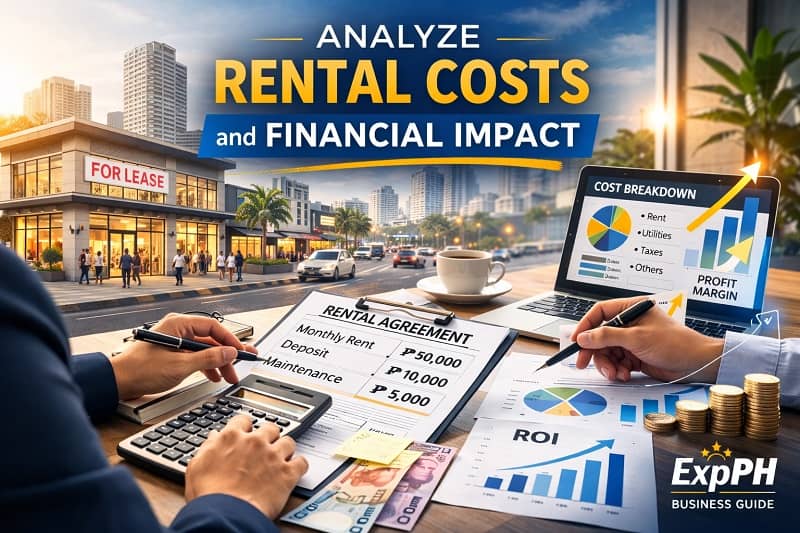
Analyze Rental Costs and Financial Impact
Rent is one of your largest fixed expenses, so it must not strain your cash flow. A practical guideline is to keep rent within 10 percent to 20 percent of projected monthly revenue. This allows room for inventory, salaries, utilities, and marketing while maintaining healthy profit margins.
Compare Commercial vs Residential Areas
Different locations offer different financial tradeoffs. Commercial districts usually provide:
- Higher rent
- Higher traffic
- Stronger competition
Residential areas typically offer:
- Lower rent
- Stable community customers
- Slower but consistent sales
The right business location Philippines entrepreneurs select depends on available capital, pricing strategy, and overall business model. Higher traffic may justify higher rent, but only if projected sales can support the cost structure.
Review Contract Terms Carefully
Before signing any lease agreement, examine important contract details such as:
- Length of lease
- Annual rent increase clause
- Security deposit requirements
- Renovation permissions
Unfavorable terms can limit flexibility and increase long term expenses. If you are unsure about legal conditions, review official guidance from the Department of Trade and Industry at https://www.dti.gov.ph. DTI resources also clarify business registration requirements that may affect your chosen location.

Study the Competition
Competition is not always a negative sign. In many cases it confirms that customers already visit the area to buy similar products or services. Instead of avoiding competitors immediately, analyze what their presence reveals about demand, customer habits, and overall market strength.
When Competition Is Good
If you notice several food stalls or similar businesses in one location, it may indicate:
- Strong demand
- High foot traffic
- Established customer habit
Food parks across many Philippine cities succeed because customers expect variety in one place. When buyers already associate an area with a specific product category, new businesses can benefit from shared customer flow and collective visibility.
When Competition Is Dangerous
Competition becomes risky when you:
- Directly compete with a dominant brand next door
- Enter a saturated micro market without differentiation
Walk around and list all competitors within a 200 meter radius. Observe their pricing, customer volume, and product positioning. Ask yourself what they do well and identify what unique value you can offer to stand out clearly in the same area.
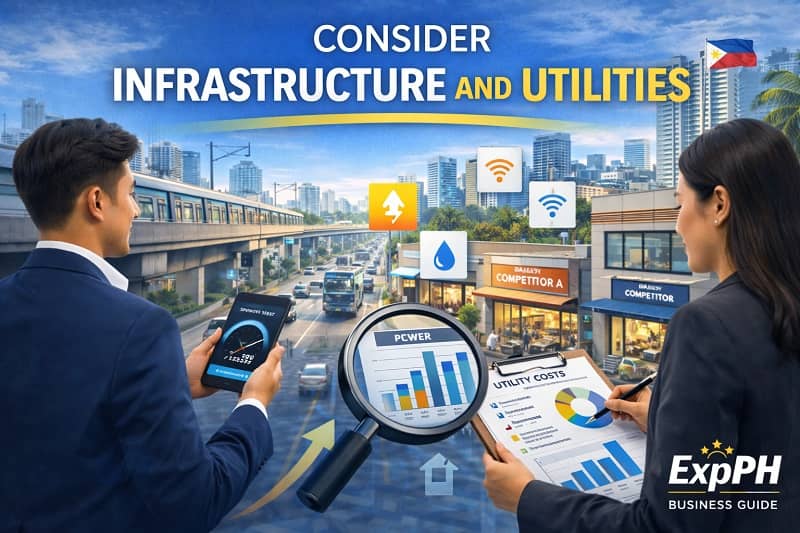
Consider Infrastructure and Utilities
Reliable infrastructure is essential for smooth daily operations in the Philippines. Weak utilities can interrupt service, damage equipment, and reduce customer satisfaction. Before finalizing a lease, evaluate whether the area provides stable power, clean water, and dependable connectivity that supports your business model.
Power and Water Stability
Frequent power interruptions can severely affect operations for:
- Restaurants
- Computer shops
- Tech startups
- Cold storage businesses
Electricity issues may cause food spoilage, data loss, or service delays. Water supply problems can also disrupt cleaning and production processes. Speak with nearby tenants and residents to understand outage frequency and how long interruptions usually last before committing.
Internet Connectivity
If your business relies on online sales, POS systems, or cloud accounting software, stable internet is necessary. Many businesses across the Philippines now depend on digital tools such as:
- Online ordering
- E wallet transactions
- Digital bookkeeping
A strong and consistent connection improves transaction speed, financial tracking, and overall customer experience, helping your operations remain efficient and competitive.
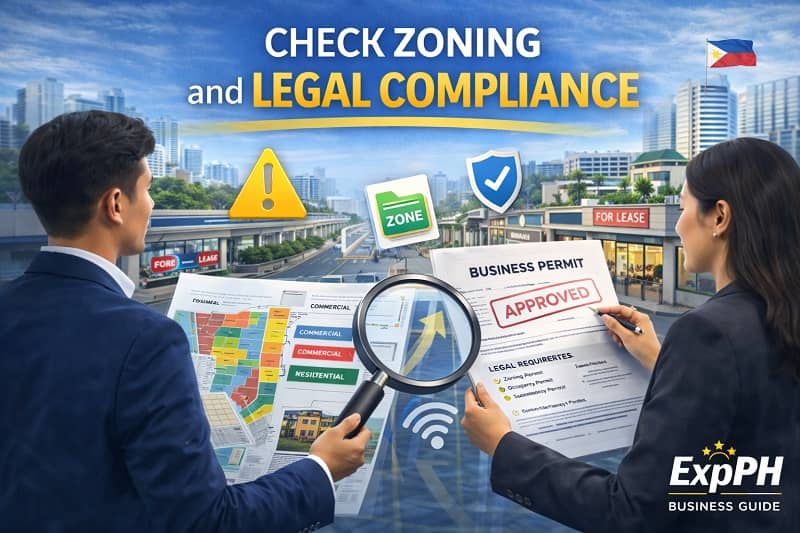
Check Zoning and Legal Compliance
Legal compliance is an essential step when selecting a business location in the Philippines. Local government units regulate where specific types of businesses may operate. Ignoring these requirements can delay your opening or cause operational problems after your business begins serving customers.
Before finalizing a lease, verify the following requirements with the local government:
- Zoning classification
- Barangay clearance requirements
- Environmental compliance if applicable
These regulations ensure that your business activity is allowed in the selected area. Some commercial operations require additional permits depending on industry type and environmental impact.
If you are forming a corporation, registration requirements can be confirmed through the Securities and Exchange Commission at https://www.sec.gov.ph. Sole proprietors must register through the Department of Trade and Industry. Choosing a location that violates zoning rules may lead to penalties or forced closure.

Assess Safety and Risk Factors
Safety plays a significant role in the success of a business location. Customers and employees prefer areas where they feel secure. If a location appears unsafe, people may avoid visiting even when the products or services offered are attractive and reasonably priced.
Crime Rate and Lighting
Visit the location during evening hours to evaluate safety conditions. Observe the surrounding environment and consider the following questions:
- Is the area well lit?
- Are there visible security personnel?
- Do nearby stores close early due to safety concerns?
Customers generally avoid areas that appear unsafe or poorly maintained. A well lit and secure environment encourages people to visit and stay longer.
Flooding and Disaster Risk
Flooding remains a serious concern in many parts of the Philippines, especially during heavy rainfall and typhoon season. Before choosing a location, review important risk indicators such as:
- Is the area flood prone?
- Are there proper drainage systems?
- Has the location been submerged during heavy rains?
Flood damage can destroy inventory, equipment, and furniture. Understanding local disaster risks helps protect your investment and maintain stable operations.

Think About Long Term Growth
Choosing a business location should involve more than evaluating current conditions. A strong location supports future expansion and market growth. Consider how the surrounding area may develop over time and whether it can continue supporting your operations as your business grows.
Look at Upcoming Developments
Research future development plans in the surrounding area. These projects can increase business opportunities and customer traffic. Ask questions such as:
- Are there planned malls?
- Is there a future transport project?
- Is the area being developed into a commercial zone?
Infrastructure improvements often attract more visitors and raise property value. Businesses located near growing commercial zones often benefit from increased visibility and stronger long term demand.
Scalability
Your location should also support business expansion if growth occurs. Evaluate the space and surrounding area by asking:
- Can you expand if your business grows?
- Is there adjacent space available?
- Can you add storage or a second floor?
Planning for scalability reduces the need for expensive relocation. Choosing a flexible location allows your business to grow without major operational disruption.
Quick Business Location Checklist
Before signing any lease agreement, review key factors that influence business success. A careful checklist helps prevent costly mistakes and ensures the location supports your long term goals. Confirm that the property meets essential operational, financial, and market requirements.
Before committing to the location, verify the following:
- Target market alignment
- Strong foot traffic
- Reasonable rent ratio
- Legal compliance
- Utility stability
- Safe surroundings
- Growth potential
If most of these factors are present, the location likely offers a strong foundation for your venture. The right business location Philippines entrepreneurs choose supports steady customer demand, manageable operating costs, and long term expansion opportunities.

Final Thoughts
Choosing the right business location Philippines entrepreneurs can rely on is not simply about selecting the cheapest rent or the busiest street. The real goal is strategic alignment between your location, your customers, and your financial capacity. A strong location should support your target market, fit within your operating budget, and comply with local regulations. It should also provide room for business expansion as demand grows. When these factors work together, your location becomes a valuable asset rather than a constant operational challenge.
Take time to evaluate several locations before making a final decision. Visit potential sites at different times of the day, observe customer activity, and compare rental terms carefully. Study nearby businesses and assess infrastructure conditions that may affect operations. Careful planning reduces costly mistakes and improves long term stability. A thoughtful location decision creates a strong foundation for success in the Philippine business environment and increases the chances that your business will grow and thrive in the years ahead.
More Business Resources
Explore these practical guides from ExpPH Business Guide. Each article provides clear steps, real world insights, and Philippines focused advice to help you manage finances, compete in the market, and grow your business with confidence.
- How to Keep Simple Business Records Without an Accountant
- How Filipino Small Businesses Can Compete With Bigger Companies
- How to Price Your Products or Services as a Filipino Business Owner
- Business Bank Accounts in the Philippines: What You Need to Know
- How to Use a Website to Grow a Small Business in the Philippines
Continue exploring ExpPH Business Guide to learn more practical strategies that can help Filipino entrepreneurs start, manage, and grow successful businesses.
Frequently Asked Questions
1. Why is choosing the right business location important in the Philippines?
Choosing the right location affects customer traffic, rental expenses, accessibility, and long term profitability. A strategic area increases visibility, strengthens competitiveness, and supports sustainable business growth.
2. How do I know if an area has enough customers for my business?
Observe foot traffic at different times, study nearby establishments, and analyze local demographics. Check if your target market regularly visits or lives within the area.
3. What percentage of revenue should go to rent?
Many entrepreneurs allocate around ten to twenty percent of projected monthly revenue for rent, ensuring enough funds remain for operations, inventory, salaries, and marketing.
4. Is it better to open in a commercial district or residential area?
Commercial districts offer higher visibility and traffic, while residential areas provide stable community customers and lower rent. Your choice depends on budget, product type, and goals.
5. How can I check if a location is legally allowed for my business?
Visit your local government unit to confirm zoning classification and permit requirements. Barangay clearance and business registration compliance are necessary before finalizing any lease agreement.
6. Should I avoid areas with many competitors?
Not always. Competitors may indicate strong demand and customer presence. However, ensure your product or service offers clear differentiation to avoid price wars.
7. What infrastructure factors should I evaluate before renting?
Check power stability, water supply reliability, internet connectivity, road access, drainage systems, and parking availability to ensure smooth daily operations and customer convenience.
8. How do I assess if an area is safe for customers?
Visit during daytime and nighttime to observe lighting, security presence, and nearby activity. Ask neighboring businesses about safety concerns and past incidents.
9. Is foot traffic more important than low rent?
High foot traffic can generate stronger sales, but excessive rent reduces profitability. Balance visibility with affordability to maintain healthy cash flow and sustainable operations.
10. Should I consider future development plans before choosing a location?
Yes, upcoming infrastructure projects, transport improvements, or commercial developments can increase customer flow and property value, supporting long term growth and expansion opportunities.
HD Quiz Hub!
Test your understanding of the key strategies for choosing the right business location in the Philippines.
Results


#1. Why is business location important?
#2. What should you study first before choosing a site?
#3. Ideal rent should usually be:
#4. What indicates strong retail potential?
#5. Before signing a lease, verify:
#6. Competition in an area may signal:
#7. Which utility is crucial for tech-based businesses?
#8. Visiting a site at different times helps you evaluate:
#9. Flood risk assessment helps prevent:
#10. Future infrastructure projects may:
Thank you for taking the quiz.
Share your score or experience in the comments and let us know how confident you feel about choosing the right business location in the Philippines.