

Starting a business is a meaningful milestone that brings both opportunity and responsibility. One of the earliest and most important decisions you must make is selecting the right Business Structure in the Philippines. This choice influences how your company is taxed, your level of personal liability, your capital requirements, and how daily operations are managed. It also shapes how banks, partners, and potential investors assess your credibility and long term potential.
In the Philippines, entrepreneurs usually choose among three primary structures: sole proprietorship, partnership, and corporation. Each option offers distinct advantages and specific limitations that can influence your business direction. Understanding how these structures work in practice helps protect personal assets, manage financial risk, and position your enterprise for sustainable growth. Careful evaluation at the beginning reduces the risk of costly changes later.
This guide explains each structure in clear and practical terms, including Philippine specific regulations and real world considerations.
Table of Contents
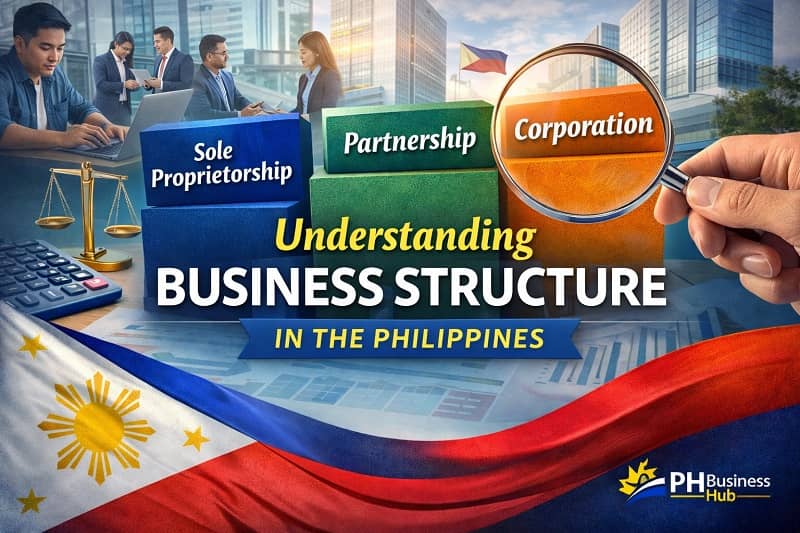
Understanding Business Structure in the Philippines
Before registering your company, you must choose the legal structure that matches your goals and long term plans. In the Philippines, business types are regulated by specific government agencies depending on their classification and legal framework:
Sole proprietorships are registered with the Department of Trade and Industry
Partnerships and corporations are registered with the Securities and Exchange Commission
You can verify official procedures, registration steps, and updated requirements directly through the Department of Trade and Industry and the Securities and Exchange Commission websites to ensure full compliance with current Philippine regulations.
Selecting the right structure goes beyond completing forms. Your chosen setup shapes how your business operates and grows in practical terms:
- Who owns the business
- Who is responsible for debts
- How profits are taxed
- How key decisions are made
- How easily capital can be raised
Understanding these factors helps you build a stable foundation before moving forward with registration.

How to Choose the Right Business Structure in the Philippines
Selecting the appropriate Business Structure in the Philippines requires careful evaluation of your goals, risk tolerance, and long term plans. The right choice should support your operations today while allowing flexibility and protection as your enterprise grows and faces new opportunities or challenges.
Consider these practical questions before making a decision:
- Are you starting alone or with partners
- How much personal risk can you accept
- Do you plan to raise significant capital
- Is your target local or national expansion
- Do you need strong investor confidence
If you are launching a small venture with limited financial exposure, a sole proprietorship may be sufficient. It allows full control and simpler compliance while you test your business model and manage manageable levels of risk.
If you are forming a professional service firm with trusted collaborators, a partnership can provide shared capital and expertise. Clear agreements and defined responsibilities help maintain stability and reduce misunderstandings among partners.
If you want limited liability protection, stronger credibility, and better access to investors, forming a corporation may be the most strategic option. This structure supports expansion and provides a formal framework for long term business growth.
3 Powerful Business Structure in the Philippines

1. Sole Proprietorship in the Philippines
A sole proprietorship is the simplest and most widely used business structure in the Philippines. It is common among small enterprises, freelancers, online sellers, and home based entrepreneurs who want an affordable and straightforward way to start operating legally.
What Is a Sole Proprietorship
A sole proprietorship is owned and managed by one individual. The business and the owner are legally the same, meaning there is no separate legal personality. Once you register your business name with DTI and operate under it, you are officially recognized as a sole proprietor.
Advantages of a Sole Proprietorship
A sole proprietorship offers practical benefits for beginners and small operators who want minimal complexity:
- Easy and inexpensive registration
- Full control over decisions
- Simple tax compliance compared to corporations
- Suitable for small or low risk businesses
This structure is widely used by sari sari store owners, online resellers, consultants, and service providers across the country.
Disadvantages of a Sole Proprietorship
Despite its simplicity, this structure also carries important risks and limitations:
- Unlimited personal liability
- Limited ability to raise capital
- Business ends if owner stops
Unlimited liability means your personal assets, including savings and property, may be used to settle business debts. While this setup works for small ventures, long term expansion may require a more structured legal form.

2. Partnership in the Philippines
A partnership is created when two or more individuals agree to contribute money, property, or services to a common business with the goal of sharing profits. This structure allows multiple people to combine resources and operate under a formal legal arrangement recognized in the Philippines.
Types of Partnerships
Under Philippine law, partnerships are generally classified into two main types:
- General partnership
- Limited partnership
In a general partnership, all partners may be personally liable for business obligations. In a limited partnership, limited partners are liable only up to their capital contribution, provided they do not take part in active management.
Advantages of a Partnership
A partnership offers practical benefits when two or more people want to build a business together:
- Shared capital and resources
- Shared skills and expertise
- Greater funding potential than sole proprietorship
This structure is commonly used by professional groups such as accounting firms, law offices, and family owned enterprises that rely on collaboration.
Disadvantages of a Partnership
Partnerships also involve risks that must be carefully managed:
- Possible conflicts between partners
- Shared liability in general partnerships
- Profit sharing reduces individual earnings
A written partnership agreement is essential. It should clearly define capital contributions, roles, profit distribution, and dispute resolution. For entrepreneurs working with trusted partners who prefer flexibility over corporate formality, this structure can be a practical option.

3. Corporation in the Philippines
A corporation is a separate legal entity distinct from its owners and shareholders. It is registered with the Securities and Exchange Commission and governed by the Revised Corporation Code of the Philippines. This structure provides a formal framework for organized and scalable business operations.
What Is a Corporation
A corporation may be formed by one stockholder through a One Person Corporation or by multiple incorporators. Because it has its own legal personality, it can perform actions independently of its owners:
- Own property
- Enter contracts
- Sue and be sued
- Continue despite ownership changes
This legal separation allows the business to operate continuously even when shareholders change over time.
Advantages of a Corporation
A corporation offers significant benefits for entrepreneurs aiming for structured growth and stronger market presence:
- Limited liability protection
- Stronger credibility with banks
- Easier access to capital
- Perpetual existence
Limited liability ensures shareholders are responsible only up to their invested amount. This structure suits businesses planning to expand nationally or attract serious investors.
Disadvantages of a Corporation
Despite its advantages, a corporation involves greater responsibility and regulatory oversight:
- More complex registration process
- Higher compliance requirements
- Formal bookkeeping standards
Corporations must file regular reports with the SEC and follow governance rules. Accounting and tax compliance costs are typically higher than those of sole proprietorships.

Comparing the Three Business Structures
To help you decide wisely, it is useful to review a clear comparison of each Business Structure in the Philippines. Understanding ownership, liability, capital capacity, and regulatory oversight allows entrepreneurs to align their choice with long term goals and acceptable levels of financial risk.
Ownership
Each structure differs in how ownership is defined and distributed among individuals:
- Sole Proprietorship: One owner
- Partnership: Two or more partners
- Corporation: One or more shareholders
Ownership affects control, profit sharing, and succession planning. Sole proprietors retain full authority, while partnerships and corporations divide rights according to agreed terms or shareholdings.
Liability
Liability determines the extent of personal financial risk faced by owners:
- Sole Proprietorship: Unlimited
- Partnership: Unlimited for general partners
- Corporation: Limited to investment
Unlimited liability means personal assets may cover business debts. Corporations provide stronger protection because shareholders are generally liable only up to their invested capital.
Capital Raising
Access to funding varies significantly depending on the chosen structure:
- Sole Proprietorship: Limited
- Partnership: Moderate
- Corporation: Strong
Corporations can issue shares and attract investors more easily. Partnerships can combine partner contributions, while sole proprietors often rely on personal savings or loans.
Regulatory Body
Each structure is supervised by a specific government agency in the Philippines:
- Sole Proprietorship: Department of Trade and Industry (DTI)
https://www.dti.gov.ph - Partnership: Securities and Exchange Commission (SEC)
https://www.sec.gov.ph - Corporation: Securities and Exchange Commission (SEC)
https://www.sec.gov.ph
The regulatory body determines registration procedures and compliance requirements. Choosing the correct structure ensures proper registration and smoother coordination with the appropriate government authority.
Each business structure serves a distinct purpose. Your final choice should reflect your growth plans, financial capacity, and willingness to manage legal responsibilities responsibly.

Financial and Tax Considerations
Choosing the right Business Structure in the Philippines directly affects your tax responsibilities and financial reporting obligations. Each structure follows different tax rules, which influence how profits are declared, how much tax is paid, and what compliance requirements must be regularly fulfilled.
All businesses must register with the Bureau of Internal Revenue and follow national tax regulations. However, income taxation varies depending on the structure you select:
- Sole proprietors are taxed as individuals
- Partnerships are taxed as entities
- Corporations are taxed as entities
Corporations are subject to corporate income tax rates and stricter reporting standards. They must file regular financial statements and comply with formal accounting practices required by law.
If you are uncertain about your tax obligations, consulting a licensed accountant is a practical step. Proper tax planning helps avoid penalties, ensures compliance, and supports stronger long term financial stability for your business.

Technology and Digital Compliance
In today’s digital economy, your chosen business structure influences the type of technology and systems your company needs. As operations grow, financial tracking, compliance monitoring, and digital reporting requirements become more structured and demand appropriate tools.
For example, different structures typically adopt varying levels of technology:
- Corporations often require structured accounting systems
- Partnerships may use shared financial platforms
- Sole proprietors may start with basic bookkeeping software
If you plan to run an ecommerce store, accept online payments, or expand nationwide, a corporate structure can strengthen credibility with banks and payment providers. It often supports smoother financial integration and more organized reporting processes.
When your legal structure aligns with your growth strategy, technology adoption becomes more efficient. A well planned setup helps ensure compliance, improves financial transparency, and supports long term digital scalability.
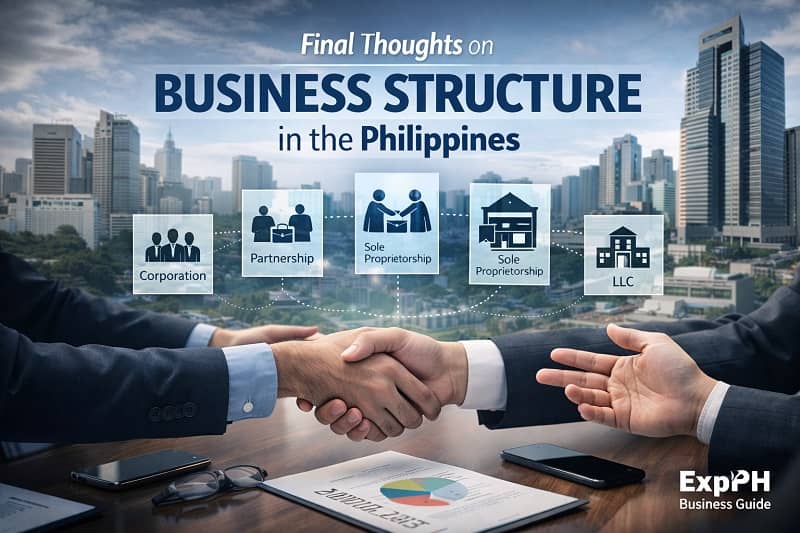
Final Thoughts on Business Structure in the Philippines
Choosing the right Business Structure in the Philippines goes beyond completing registration documents. It is a strategic decision that influences your liability exposure, tax obligations, funding capacity, and long term expansion plans. A well considered choice builds stability and prepares your company for sustainable growth.
Each structure provides distinct advantages depending on your business direction:
- Sole proprietorship offers simplicity and full control
- Partnership allows collaboration and pooled resources
- Corporation provides liability protection and scalability
There is no universal solution that fits every entrepreneur. The most suitable structure depends on your goals, tolerance for financial risk, and available capital. Careful evaluation helps ensure your chosen setup aligns with both present operations and future ambitions.
If you are committed to building a compliant and sustainable enterprise, take time to study your options thoroughly. Seek professional advice when needed and confirm official requirements with the appropriate government agencies to avoid costly mistakes.
A strong business foundation starts with the right structure. When you choose carefully and plan responsibly, your company gains clearer direction, stronger credibility, and better opportunities for long term success.

FAQs About Business Structure in the Philippines
1. What is the main difference between sole proprietorship, partnership, and corporation in the Philippines?
The main difference lies in ownership structure, liability exposure, and legal personality. Corporations are separate entities, while sole proprietors and general partners carry personal liability.
2. Which business structure is easiest to register in the Philippines?
A sole proprietorship is the easiest to register because it only requires business name registration with DTI, followed by local permits and BIR registration requirements.
3. Which structure offers the strongest liability protection?
A corporation offers the strongest liability protection because it has a separate legal personality, limiting shareholder responsibility to their invested capital in most cases.
4. Can one person form a corporation in the Philippines?
Yes, one person can form a corporation through a One Person Corporation, which allows a single stockholder to operate with limited liability protection.
5. How are taxes different among these business structures?
Sole proprietors are taxed as individuals, while partnerships and corporations are taxed as separate entities, subject to corporate tax rules and reporting obligations.
6. Which business structure is best for small startups?
For small startups with limited capital and simple operations, a sole proprietorship is often practical because it requires minimal paperwork and lower compliance costs.
7. Is a partnership risky in terms of liability?
Yes, in a general partnership, partners can be personally liable for debts and obligations, especially if business assets are insufficient to cover liabilities.
8. Which structure is better for attracting investors?
A corporation is generally better for attracting investors because it can issue shares, establish formal governance structures, and provide clearer ownership arrangements.
9. What government agencies regulate these business structures?
Sole proprietorships register with DTI, while partnerships and corporations register with the SEC, and all must comply with BIR and local government requirements.
10. How should entrepreneurs choose the right structure?
Entrepreneurs should consider ownership plans, liability tolerance, capital needs, and growth goals, then evaluate which structure aligns best with their long term strategy.
More Business Resources
Continue building your knowledge with these practical and Philippines focused guides designed to help entrepreneurs make informed decisions and avoid costly mistakes:
- Common Mistakes First-Time Filipino Entrepreneurs Should Avoid
- How Much Capital Do You Really Need to Start a Business in the Philippines
- Essential Digital Tools Every Small Business in the Philippines Should Use
- How to Start a Small Business in the Philippines Step by Step
- Types of Businesses You Can Register in the Philippines
These resources provide deeper insights into business planning, capital preparation, legal registration, and strategic decision making to support your long term success.
HD Quiz Hub!
Test your understanding of sole proprietorship, partnership, and corporation through this quick learning quiz.
Results


#1. Which structure has no separate legal personality?
#2. Which structure provides limited liability protection?
#3. Which agency registers sole proprietorships?
#4. Which structure requires at least two partners?
#5. Which structure can issue shares of stock?
#6. Who has unlimited liability in a sole proprietorship?
#7. Which structure suits small home businesses?
#8. Which structure is best for attracting investors?
#9. Partnerships are registered with which agency?
#10. Which factor is most important when choosing a structure?
Thank you for taking the quiz.
Share your score or insights in the comments and let us know which business structure fits your goals best.