

Starting a business is an exciting milestone, but before offering products or services, you must complete your business name registration Philippines process correctly. Proper registration gives your enterprise legal recognition and protects your chosen name from misuse. It also strengthens credibility with customers, suppliers, banks, and potential partners. Taking this step seriously ensures you begin operations on solid legal ground and reduces the risk of compliance issues that could disrupt your growth later.
In this comprehensive guide, you will understand the complete process of registering a business name in the Philippines. We will cover the required steps, responsible government agencies, registration fees, expected timelines, and practical tips to avoid common mistakes. The focus remains on Business Philippines compliance, while also highlighting relevant finance and technology considerations that help new entrepreneurs build sustainable and organized operations.
Table of Contents

Why Business Name Registration Is Important
Before moving into the detailed steps, it is important to understand why registering your business name is a critical foundation for any entrepreneur in the Philippines. Proper registration strengthens your credibility, protects your identity, and ensures that your business operates within the boundaries of Philippine laws and regulations.
Legal Recognition
If you plan to operate as a sole proprietor, you are required to register your business name with the Department of Trade and Industry or DTI. Without official registration, you cannot legally conduct transactions, issue receipts, or represent your enterprise under your chosen business name.
Brand Protection
Registering your business name secures your right to use it within your approved territorial scope. This prevents other businesses from registering or operating under a confusingly similar name. Proper registration safeguards your brand identity and helps customers clearly distinguish your business in the marketplace.
Requirement for Permits and Bank Accounts
Completing your business name registration is necessary before applying for other essential permits and financial services. Most government offices and banks require proof of registration before processing applications, including:
- Apply for a Barangay Clearance
- Secure a Mayor’s Permit
- Register with the Bureau of Internal Revenue or BIR
- Open a business bank account
- Apply for business loans
Without this initial step, you cannot move forward with full legal and financial compliance.

How Long Does Business Name Registration Philippines Take?
The DTI online registration process can often be completed within one day, provided that all required conditions are met. Processing is usually fast when there are no issues with your application and all information submitted is accurate and complete:
- Your chosen name is available
- Your documents are complete
- Payment is successful
However, finishing the entire registration process, including securing local permits and completing BIR registration, may take several days or even a few weeks. Processing time depends on your local government unit, document verification, and scheduling of required inspections.
6 Proven Steps for Business Name Registration in the Philippines

Step 1: Determine Your Business Structure
Before beginning your business name registration Philippines process, you must first decide on your legal business structure. Your chosen structure determines which government agency will handle your registration, your level of liability, and the compliance requirements you must follow as your business grows.
Sole Proprietorship
If you are the only owner and fully responsible for profits, losses, and obligations, you fall under a sole proprietorship. In this case, you must register your business name with the Department of Trade and Industry. This structure is common among small and home based businesses.
You may confirm requirements and complete your application through the official DTI Business Name Registration System at: https://bnrs.dti.gov.ph
Partnership or Corporation
If your business has two or more owners and is organized as a partnership or corporation, registration is handled by the Securities and Exchange Commission rather than DTI. These structures involve shared ownership and different legal obligations compared to sole proprietorship.
For this guide, the focus remains on sole proprietorship registration under DTI since it is the most widely used structure among small businesses in the Philippines.
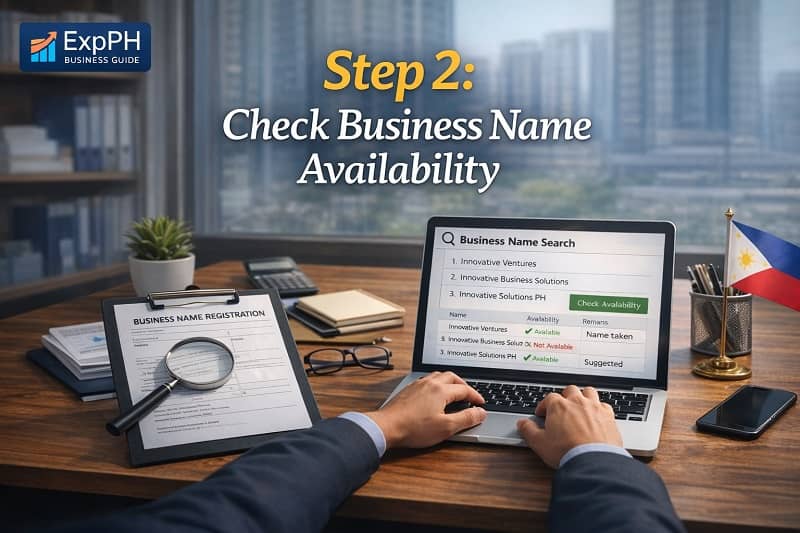
Step 2: Check Business Name Availability
Before paying any registration fees, confirm that your preferred business name is available. Securing an approved name prevents delays and protects you from legal conflicts. Checking availability early saves time and ensures your application proceeds smoothly through the DTI registration process.
Guidelines for Choosing a Business Name
The Department of Trade and Industry sets clear standards for acceptable business names. Your proposed name must follow these guidelines to avoid rejection during the review process:
- The name must not be identical or confusingly similar to an existing registered business
- It must not be offensive misleading or deceptive
- It should clearly reflect the nature of your business
- Words like Corporation or Incorporated are not allowed for sole proprietorship
You can verify availability directly through the DTI Business Name Registration System website. Prepare at least three alternative names in advance so you have backup options if your first choice is unavailable.
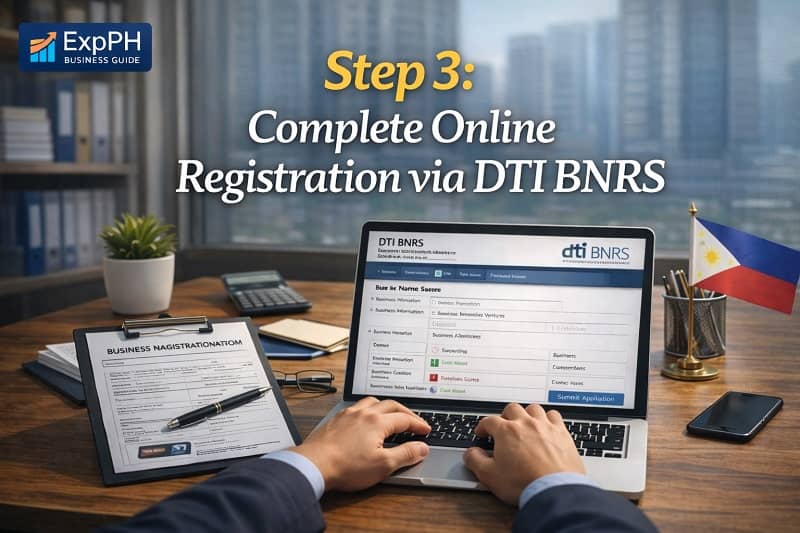
Step 3: Complete Online Registration via DTI BNRS
The business name registration Philippines process is now completed online through the DTI Business Name Registration System. This digital platform allows applicants to submit information verify details and pay fees without visiting a physical office, making the process faster and more accessible for entrepreneurs.
Information You Need to Prepare
Before starting your online application, prepare all required details to avoid delays or errors. Having accurate information ready ensures a smooth submission and faster approval from DTI:
- Full name of the owner
- Residential address
- Business address
- Valid government issued ID
- Email address and mobile number
- Business scope and line of business
Territorial Scope Options
During registration, you must select your territorial scope. This determines where your business name is protected and where you are authorized to operate under that name:
- Barangay
- City or Municipality
- Regional
- National
Choosing a wider scope increases the registration fee because it provides broader protection for your business name.
Registration Fees
Registration fees vary depending on the territorial scope you choose. Smaller coverage areas cost less while nationwide protection requires higher payment:
- Barangay level, lowest fee
- National level, highest fee
A documentary stamp tax is also required. Payments are made online through accredited channels. After successful payment, your Certificate of Business Name Registration is issued electronically.

Step 4: Secure Barangay Clearance
After completing your DTI registration, your next responsibility is securing a Barangay Clearance from the barangay where your business will operate. This clearance confirms that your planned activities comply with local community regulations and that your business is permitted within that specific area.
Requirements
Most barangays require several basic documents before issuing clearance. Preparing these in advance helps prevent delays and ensures faster processing of your application:
- DTI Certificate
- Valid government issued ID
- Proof of business address
- Completed application form
Fees vary depending on your barangay and the nature of your business. It is best to check directly with your local barangay office for updated requirements and payment details.

Step 5: Apply for Mayor’s Permit
After obtaining your Barangay Clearance, you must apply for a Mayor’s Permit at your local city or municipal hall. This permit authorizes your business to operate within the jurisdiction and confirms compliance with local regulations and safety standards.
Requirements
Local government units may require several documents before approving your application. Preparing complete and accurate paperwork helps avoid processing delays:
- DTI Certificate
- Barangay Clearance
- Lease contract or proof of ownership
- Community Tax Certificate
- Fire safety inspection certificate
Once approved, your Mayor’s Permit legally allows you to conduct business activities within your city or municipality. Operating without this permit may result in penalties or closure orders from local authorities.

Step 6: Register with the Bureau of Internal Revenue
After securing your local permits, you must register your business with the Bureau of Internal Revenue or BIR. This step ensures proper tax identification and compliance with national tax laws. Without BIR registration, you cannot legally issue official receipts or file required tax returns.
You may verify updated requirements, forms, and procedures directly through the official BIR website:
https://www.bir.gov.ph
What You Will Receive
Once your registration is approved, the BIR will issue several important documents that confirm your tax compliance and authority to operate:
- Certificate of Registration
- Authority to Print official receipts
- Registered books of accounts
Completing this step formally places your business within the Philippine tax system and ensures you can operate responsibly while meeting ongoing reporting and payment obligations.

Common Mistakes to Avoid
When managing your business name registration Philippines process, avoid common errors that can delay approval or create legal issues. Careful preparation and verification help ensure smooth registration and prevent unnecessary expenses or compliance problems during the early stages of your business.
Choosing a Name Without Checking Availability
Failing to confirm name availability before printing marketing materials or signage can lead to wasted resources. Always verify your proposed business name through the DTI system first to avoid rejection, duplication issues, or required changes after payment.
Using a Residential Address Without Local Approval
Some subdivisions and condominium buildings restrict commercial activities within residential units. Before listing your home address as your business location, confirm policies with your property administrator or homeowners association to prevent complaints, violations, or permit denial.
Delaying BIR Registration
Operating without registering with the Bureau of Internal Revenue exposes your business to penalties and possible fines. Complete your BIR registration promptly after securing local permits to ensure tax compliance and avoid complications during inspections or financial transactions.

Finance and Technology Tips for New Business Owners
Completing your registration is only the beginning of building a stable enterprise. Financial discipline and smart use of technology play a major role in long term sustainability. Establishing proper systems early helps you manage cash flow, maintain compliance, and prepare your business for future growth.
Open a Business Bank Account
After receiving your DTI Certificate and Mayor’s Permit, open a dedicated business bank account under your registered name. Keeping personal and business funds separate improves financial tracking, simplifies bookkeeping and makes tax preparation more organized and transparent for reporting purposes.
Use Digital Tools
Modern tools can simplify daily operations and strengthen financial control.
Consider integrating the following into your workflow:
- Accounting software
- E invoicing systems
- Online payment platforms
- Cloud based bookkeeping tools
Using digital solutions improves accuracy, supports regulatory compliance and provides clearer financial insights as your business expands.

Final Thoughts on Registering a Business Name in the Philippines
Completing your business name registration Philippines process lays the groundwork for building a legitimate and trustworthy enterprise. Registration is more than a legal formality, it establishes your identity in the market and signals professionalism to customers, suppliers, and financial institutions. Although the process may feel overwhelming at the beginning, approaching it step by step makes it far more manageable. Clear planning and careful compliance help you avoid delays, reduce risks, and start operations with confidence.
Begin with DTI online registration, then secure your Barangay Clearance and Mayor’s Permit before finalizing your BIR registration. After meeting these legal requirements, focus on organizing your finances and setting up proper record keeping systems. Completing each stage carefully protects your brand, strengthens credibility, and positions your business for long term stability and growth within the competitive Philippine market.
If you treat registration not as a formality but as a strategic step, you set your business up for sustainable growth from day one.

FAQs About Business Name Registration in the Philippines
1. What is business name registration in the Philippines?
Business name registration is the process of legally registering your chosen trade name with DTI, allowing you to operate as a sole proprietor in the Philippines.
2. Is DTI registration required for all small businesses?
DTI registration is required for sole proprietors. Partnerships and corporations must register with the Securities and Exchange Commission instead before operating legally.
3. How much does it cost to register a business name?
Registration fees depend on territorial scope, ranging from barangay to national coverage. Additional documentary stamp tax applies during the online payment process.
4. How long does DTI business name registration take?
Online registration through DTI can be completed within one day if your business name is available and payment is successfully processed.
5. Can I register my business name entirely online?
Yes, DTI provides an online Business Name Registration System where applicants can check availability, submit details, and pay fees without visiting offices physically.
6. Does DTI registration automatically include BIR registration?
No, DTI registration only secures your business name. You must separately register with the Bureau of Internal Revenue for tax compliance.
7. How long is a DTI business name valid?
A DTI business name registration is valid for five years. Owners must renew before expiration to continue using the registered name legally.
8. Can I use my home address for business registration?
Yes, you may use your home address, but confirm subdivision or condominium rules first, and ensure local government permits allow business operations.
9. What happens if my chosen business name is rejected?
If rejected, you must select an alternative name that follows DTI guidelines and is not identical or confusingly similar to existing registrations.
10. Do online businesses need to register with DTI?
Yes, online sellers and home based businesses must still register their business name with DTI and comply with local permits and tax requirements.
Ready to Register Your Business in the Philippines?
You’ve completed the business name step. Now learn the full process from start to finish:
How to Register a Business in the Philippines (Complete Guide)
If you are serious about building a strong foundation for your business, continue learning beyond registration. Expanding your knowledge helps you avoid costly mistakes, make informed financial decisions, and grow with confidence in the Philippine market. Explore these in-depth guides designed for aspiring and first-time Filipino entrepreneurs:
- Business Permits You Must Renew Every Year in the Philippines
- Barangay Clearance, Mayor’s Permit, and BIR Explained Simply
Each guide provides practical insights to help you move from planning to profitable operation with clarity and confidence.
HD Quiz Hub!
Test your knowledge about the business name registration process in the Philippines with this quick quiz.
Results


#1. Which agency handles sole proprietorship registration?
#2. Where can you register online?
#3. Business name validity period?
#4. Which comes after DTI registration?
#5. Who registers corporations?
#6. What is required for tax compliance?
#7. What must you check first?
#8. What affects registration fees?
#9. Online sellers must register?
#10. Why open business account?
Thank you for taking the quiz.
Share your score or experience in the comments and let us know which topic you want to learn next.

A Filipino web developer with a background in Computer Engineering. Founder of ExpPH Blog and ExpPH Business Guide, two Philippines-focused platforms covering OFW guidance, business, finance, freelancing, travel, and lifestyle. Passionate about helping Filipinos grow, he creates practical content that educates, empowers, and inspires readers nationwide.
Thank you for another informative blog. Where else could I get that kind of info written in such a perfect way? I’ve a project that I’m just now working on, and I’ve been on the look out for such information.