

Starting a business is an exciting opportunity for Filipinos who want to become entrepreneurs, build an additional source of income, or create a company that can grow over time. Whether you are planning to open a small neighborhood store, launch an online business, offer professional services, or establish a larger enterprise, understanding the process before investing your money can help you make better decisions.
However, starting a business in the Philippines involves more than choosing a product and finding customers. Entrepreneurs need to evaluate business opportunities, prepare sufficient capital, understand registration requirements, secure the necessary permits, manage finances, and establish reliable daily operations.
For first-time entrepreneurs, the process can initially feel complicated. There are different government agencies, registration procedures, tax responsibilities, and local requirements to consider. The good news is that these steps become easier to understand when approached in the right order.
This Complete Guide to Starting a Business in the Philippines explains the important decisions and practical steps involved in building a business, from choosing an appropriate business idea to managing operations and planning for future growth.
Whether you are starting with limited capital or preparing to establish a more structured company, this guide will help you understand what to consider before taking your first step.
Quick Summary (TL;DR)
Starting a business in the Philippines requires proper planning, financial preparation, and an understanding of registration requirements. Whether you want to open a small store, launch an online business, or establish a service-based company, following the right steps can help you build a sustainable business.
- Choose the right business idea: Identify products or services that address actual customer needs and market demand.
- Research the market: Understand your target customers, competitors, pricing, and business opportunities.
- Prepare your startup capital: Calculate initial investments, operating expenses, and emergency funds.
- Select a business structure: Determine whether a sole proprietorship, partnership, or corporation suits your business plans.
- Register your business: Complete the applicable registration with the appropriate government agencies.
- Secure permits and licenses: Check local government requirements and industry-specific regulations.
- Understand taxation: Register with the Bureau of Internal Revenue and maintain accurate financial records.
- Establish business operations: Organize suppliers, equipment, inventory, employees, and customer service.
- Build your customer base: Use effective marketing strategies, social media, and digital tools to reach potential customers.
- Plan for sustainable growth: Monitor business performance, manage cash flow, and improve operations as your business develops.
Key takeaway: Starting a business does not require a large investment from the beginning. Focus on a practical business idea, understand your financial responsibilities, complete the necessary registrations, and build your operations gradually as your business grows.
Ready to become an entrepreneur? Take the first step toward starting your own business in the Philippines today!
Table of Contents

1. Understanding the Business Landscape in the Philippines
The Philippines offers various opportunities for aspiring entrepreneurs across retail, food production, agriculture, transportation, professional services, and online businesses. However, choosing the right opportunity requires understanding customer demand, purchasing power, competition, and operating costs. Researching your target market helps you identify a business that matches your resources and goals.
Types of Businesses You Can Start in the Philippines
Here are some common business categories worth exploring.
1. Retail businesses
Retail businesses sell products directly to consumers. Examples include sari-sari stores, clothing shops, grocery stores, school supplies stores, beauty product shops, and specialty stores.
They can serve customers within a neighborhood or reach a wider market through online selling.
2. Food and beverage businesses
Food businesses provide products that customers purchase for daily consumption or special occasions. Examples include food stalls, bakeries, catering services, frozen food businesses, restaurants, and beverage shops.
Food businesses can attract repeat customers, but entrepreneurs must carefully manage food quality, inventory, storage, sanitation, and operating expenses.
3. Agriculture and food production
Agriculture-related businesses include poultry farming, vegetable production, fish farming, livestock raising, mushroom cultivation, and food processing.
These businesses may serve households, restaurants, retailers, wholesalers, and other commercial buyers. Their profitability depends on production costs, market prices, location, supply availability, and effective operations.
4. Service businesses
Service businesses earn income by providing skills, labor, or specialized assistance. Examples include cleaning services, appliance repair, plumbing, photography, pet grooming, and automotive maintenance.
Some service businesses can begin with relatively limited equipment, depending on the services offered.
5. Digital and professional businesses
Digital businesses use technology, specialized knowledge, or online platforms to provide services. Examples include freelance writing, virtual assistance, web design, graphic design, bookkeeping, digital marketing, and online tutoring.
These businesses may have lower physical infrastructure requirements, although entrepreneurs still need suitable equipment, reliable internet access, professional skills, and a way to acquire clients.
6. Tourism and hospitality businesses
Tourism-related businesses include homestays, vacation rentals, travel agencies, tour services, catering, and event planning.
Their performance may depend on location, tourism demand, seasonality, customer experience, and applicable local or industry regulations.
Choosing Between a Small Business and a Larger Enterprise
A small business is not necessarily less valuable than a large company. What matters is whether the business matches your resources, experience, and long-term objectives.
A small neighborhood store may be a practical starting point for someone who understands the local community. A professional services company may be more appropriate for someone with specialized skills and an established network.
Instead of choosing a business simply because it appears popular, evaluate whether you can operate it consistently and serve customers effectively.

2. How to Choose the Right Business Idea
Choosing the right business idea is essential when starting a business in the Philippines. Look for an opportunity that meets customer needs and offers realistic earning potential. You do not need an original concept, but you should choose a business that you can manage effectively in your target market.
Identify Problems Customers Need Solved
Start by observing your community or intended customer market.
Ask yourself:
- What products do people regularly purchase?
- What services are difficult to find locally?
- What problems do households or businesses experience?
- Are customers dissatisfied with existing products or services?
- Is there demand for more affordable or convenient alternatives?
For example, if your community has several residential subdivisions but limited laundry services, a laundry pickup and delivery business might be worth researching.
However, customer interest alone does not guarantee profitability. You still need to determine whether enough people are willing to pay for the service at a price that covers your expenses.
Evaluate Your Skills and Experience
Your personal capabilities can influence how efficiently you operate a business.
If you have experience in cooking, you might consider food production or catering. If you understand computers, you could explore computer repair or digital services.
Consider the following:
- Skills you already possess.
- Products or services you understand.
- Equipment you can access.
- Training you may need.
- Experience managing customers or suppliers.
Choosing a business related to your existing knowledge can make the early stages easier to manage.
Study Your Competitors
Competitor research helps you understand how other businesses serve the same market.
Visit nearby establishments, examine their product offerings, compare prices, and observe how they interact with customers.
For online businesses, examine competing websites, marketplaces, social media pages, and customer reviews.
Look for opportunities to improve something customers already value. This could involve better service, convenient delivery, clearer product information, consistent quality, or a more suitable product selection.
Avoid assuming that a market has no competition simply because you cannot find many businesses advertising online.
Test Your Business Idea Before Investing Heavily
Before renting a commercial space or purchasing large quantities of inventory, consider testing your business concept on a smaller scale.
Depending on the business and applicable requirements, you might:
- Offer a limited selection of products.
- Conduct customer interviews.
- Create product samples.
- Test different pricing options.
- Gather feedback from potential customers.
- Evaluate interest through a small marketing campaign.
The purpose is to gather practical information before committing significant resources.

3. Conducting Market Research and Understanding Your Target Customers
Market research helps entrepreneurs evaluate whether a business idea has enough potential customers to support its operations. You can begin without hiring an expensive research agency by observing your market, talking to potential customers, studying competitors, and conducting simple surveys to understand customer needs and purchasing behavior.
Define Your Target Market
Your target market consists of the people or organizations most likely to purchase your products or services.
For example, a school supplies business may primarily serve students, parents, teachers, and educational institutions.
A bookkeeping service may target freelancers, small businesses, and entrepreneurs who need assistance organizing financial records.
Understanding your target customers helps you decide what to sell, how to price it, and where to promote it.
Research Customer Purchasing Behavior
Look beyond whether people like your product. Determine whether they are actually willing and able to purchase it.
Consider:
- How frequently customers need the product.
- How much they normally spend.
- Where they currently purchase similar products.
- What influences their purchasing decisions.
- What would encourage them to choose your business.
For example, customers may appreciate a food delivery service but only use it when delivery fees and food prices fit their budgets.
Evaluate Your Business Location
For businesses that serve customers in person, location can significantly influence sales.
Consider accessibility, visibility, nearby residential areas, customer traffic, parking, transportation, and competing establishments.
A location with heavy foot traffic may appear attractive, but higher rental costs can reduce profitability.
For home-based businesses, consider available space, delivery access, neighborhood restrictions, and whether the planned activity is allowed at the property.

4. Preparing Your Startup Capital and Business Budget
Preparing sufficient startup capital is essential when starting a business in the Philippines. Beyond the initial investment, entrepreneurs must account for monthly operating expenses such as rent, inventory, utilities, and salaries. A realistic budget and emergency reserve help maintain daily operations and manage unexpected financial challenges.
Identify Your Initial Startup Expenses
Your startup costs depend on the nature and scale of your business.
Common expenses include:
Business registration and permits: Government registration fees, local permits, licenses, and applicable professional or industry requirements.
Equipment and tools: Computers, kitchen equipment, machinery, furniture, delivery equipment, or other tools needed for operations.
Initial inventory: Products, ingredients, packaging materials, and supplies required to begin selling.
Rental and renovation expenses: Advance rent, deposits, repairs, improvements, and preparation of the business location.
Marketing expenses: Signage, product photography, promotional materials, website development, and initial advertising.
Technology expenses: Internet connection, software subscriptions, payment systems, and business management tools.
Professional services: Accounting assistance, legal advice, consulting, and other specialized services when necessary.
Calculate Your Monthly Operating Expenses
After estimating startup expenses, prepare a separate monthly operating budget.
| Expense | Examples |
|---|---|
| Rent | Store, office, or warehouse |
| Utilities | Electricity, water, internet |
| Inventory | Products and raw materials |
| Salaries | Employee compensation |
| Transportation | Delivery and logistics |
| Marketing | Advertising and promotions |
| Maintenance | Repairs and equipment servicing |
| Administrative | Accounting and office supplies |
Do not assume that every business will have all these expenses. Include only those that apply to your operating model.
Prepare an Emergency Reserve
An emergency reserve provides additional financial flexibility when sales are lower than expected or unexpected expenses arise.
For example, a food business may experience higher ingredient prices, equipment breakdowns, or temporary interruptions in customer demand.
Your reserve should be based on your business’s expected monthly expenses, available capital, and risk exposure.
Avoid using all your available money for equipment and inventory without leaving enough funds to support normal operations.
Understand the Difference Between Revenue and Profit
Revenue is the money your business earns from selling products or services.
Profit is what remains after the relevant business expenses have been deducted.
For example, imagine a small business generates ₱100,000 in monthly sales. Its expenses total ₱82,000.
Its operating surplus before other applicable taxes and adjustments is ₱18,000.
This distinction is important because high sales do not automatically mean a business is financially healthy.
5. Choosing the Right Business Structure in the Philippines
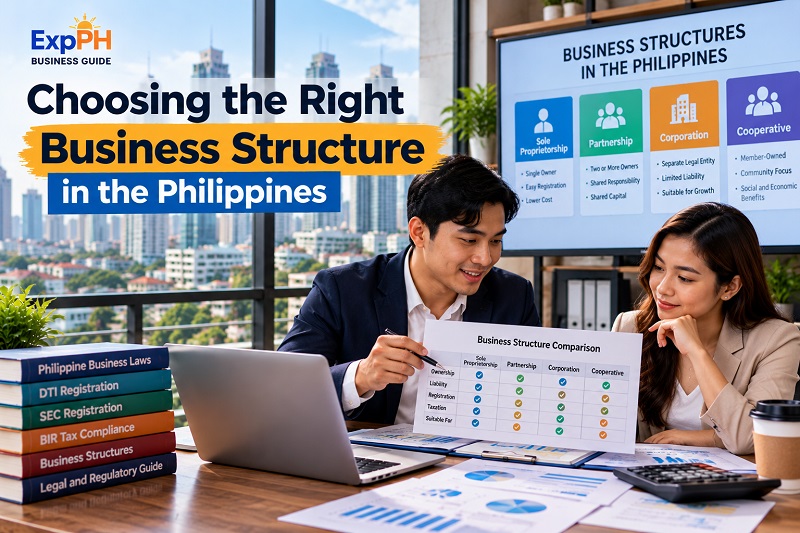
Choosing the right business structure is an important step before registering your business in the Philippines. Your decision affects ownership, management responsibilities, legal obligations, and registration requirements. Understanding the differences between sole proprietorships, partnerships, and corporations helps you select a structure that suits your business plans.
Sole Proprietorship
A sole proprietorship is owned by one individual.
The owner generally controls the business, makes operating decisions, receives its profits, and is personally responsible for its obligations.
This structure is commonly considered by individuals establishing small businesses, professional activities, and independently operated enterprises.
If you use a business name different from your true name, DTI business name registration is generally required.
However, registering a business name does not automatically authorize you to operate. Applicable local permits and tax registration must also be addressed.
Partnership
A partnership involves two or more individuals or entities agreeing to conduct business together.
Partners contribute resources, share responsibilities, and divide profits according to their agreement.
A partnership may be suitable when people have complementary skills, financial resources, or business experience.
Before establishing one, prepare a written agreement covering ownership contributions, responsibilities, profit distribution, decision-making, dispute resolution, and withdrawal arrangements.
Partnerships are registered with the Securities and Exchange Commission under the applicable requirements.
Corporation
A corporation is a separate juridical entity established under Philippine law.
It may be appropriate for entrepreneurs who want a more formal organizational structure, multiple investors, defined ownership arrangements, or a business designed for larger operations.
Corporations have additional compliance, reporting, governance, and administrative responsibilities.
The Securities and Exchange Commission provides online company registration through its eSPARC platform. Its available processing options include OneSEC for qualifying domestic stock corporations and regular processing for other eligible company types.
How to Decide Which Structure Is Appropriate
Consider these questions before making your decision:
- Will you own the business alone or with other people?
- How much capital will each owner contribute?
- What level of personal liability are you prepared to accept?
- Will you seek outside investors?
- What administrative and reporting responsibilities can you manage?
- Does your intended industry have specific ownership or licensing requirements?
There is no single business structure that works for every entrepreneur. If your business involves multiple investors, significant liabilities, or complicated ownership arrangements, consider obtaining professional legal and accounting advice.

6. Registering Your Business in the Philippines
Registering your business in the Philippines involves completing the requirements set by the appropriate government agencies. Depending on your business structure and activities, this may include DTI or SEC registration, local business permits, and BIR tax registration. Understanding each step helps you prepare the necessary documents and establish your business properly.
Step 1: Register Your Business Name With the DTI When Applicable
For sole proprietorships using a business name other than the owner’s true name, the business name generally needs to be registered with the DTI.
The DTI Business Name Registration System allows eligible applicants to submit applications and complete registration transactions online.
Before applying, prepare your proposed business name and relevant applicant information.
You can access the official registration platform through the DTI Business Name Registration System.
Remember that a DTI business name certificate is not a substitute for a Mayor’s Permit or other operating licenses.
Step 2: Register a Partnership or Corporation With the SEC
Partnerships and corporations generally register with the SEC rather than the DTI.
The requirements depend on the company type and ownership arrangement.
For example, a One Person Corporation has different organizational requirements from a corporation with several incorporators.
Entrepreneurs can review the applicable procedures through SEC eSPARC.
Prepare the required company information and documents before submitting an application.
Step 3: Secure Barangay Clearance and the Appropriate Local Business Permit
After the applicable business registration, coordinate with the barangay and city or municipal government where the business will operate.
Depending on the location and business activity, requirements may include:
- Barangay clearance.
- Business or Mayor’s Permit.
- Zoning or locational clearance.
- Fire Safety Inspection Certificate.
- Sanitary permit.
- Building or occupancy documents.
- Other industry-specific clearances.
Not every business requires every document listed above.
Requirements differ among local government units and depend on the premises and activities involved. A food establishment, for example, may have additional sanitation requirements compared with a home-based online service.
Contact the local Business Permits and Licensing Office (BPLO) before signing a lease or beginning operations.
The Board of Investments provides general information about local business permit requirements, including the need to confirm procedures with the relevant city or municipality.
Step 4: Register With the BIR
Businesses must comply with applicable tax registration requirements.
The BIR registration process establishes the business’s tax registration and related responsibilities.
Depending on your taxpayer classification and business structure, you may need to prepare identification documents, business registration documents, and other supporting requirements.
The BIR provides its New Business Registration Portal as an application channel for eligible new business registrants.
You should also review the BIR’s official Registration Requirements to understand the applicable registration and secondary registration requirements.
Step 5: Prepare Your Books of Accounts and Invoicing Process
Proper bookkeeping is necessary for monitoring transactions, preparing financial reports, and meeting applicable tax obligations.
Businesses need to follow the BIR rules concerning their books of accounts and invoices.
Depending on eligibility and the accounting method, available book formats include manual, loose-leaf, and computerized books of accounts.
The BIR has clarified the available options for new business registrants in Revenue Memorandum Circular No. 65-2025.
Do not assume that buying an ordinary receipt book or installing accounting software automatically satisfies all BIR requirements. Confirm the applicable invoicing and bookkeeping procedures before using them.
Step 6: Complete Employer Registration When Hiring Employees
If you plan to hire employees, additional employer registrations and responsibilities may apply.
These include obligations involving:
- Social Security System (SSS).
- Philippine Health Insurance Corporation (PhilHealth).
- Home Development Mutual Fund (Pag-IBIG Fund).
- Applicable labor standards and employee documentation.
- Payroll withholding and other tax obligations.
The Philippine Business Hub provides a gateway to certain employer-related registration processes following eligible company registration applications.
Business owners should understand these responsibilities before recruiting their first employees.

7. Understanding Business Taxes and Financial Responsibilities
Understanding business taxes and financial responsibilities is essential when starting a business in the Philippines. Entrepreneurs need to know their applicable tax obligations and filing schedules while maintaining accurate financial records. Proper financial management also helps separate personal and business funds and monitor the company’s financial performance.
Understand Your Applicable Tax Obligations
Depending on the business and its circumstances, tax obligations may involve:
- Income tax.
- Value-added tax (VAT), when applicable.
- Percentage tax, when applicable.
- Withholding taxes, when applicable.
- Other applicable national and local taxes.
Do not assume that all small businesses follow the same tax treatment.
For example, a qualifying non-VAT taxpayer may have different obligations from a VAT-registered business.
The appropriate tax treatment should be determined using current BIR rules and the business’s actual circumstances.
Maintain Accurate Financial Records
Keep organized records of your business transactions.
Important records may include:
- Sales invoices.
- Purchase invoices.
- Supplier receipts and supporting documents.
- Expense records.
- Payroll information.
- Bank statements.
- Inventory records.
- Books of accounts.
Accurate records make it easier to understand business performance and prepare required tax filings.
They also help entrepreneurs identify unnecessary expenses, monitor outstanding payments, and evaluate whether the business is generating sufficient cash.
Separate Personal and Business Money
Mixing personal and business funds can make financial management difficult.
Open a separate business bank account when appropriate and maintain clear documentation of money entering and leaving the business.
For sole proprietors, the legal and banking arrangements may differ from those of corporations, but keeping separate transaction records remains a useful management practice.
This helps you determine whether your business is actually earning money rather than simply using personal funds to cover operating expenses.

8. Finding a Suitable Business Location
Choosing a suitable business location requires understanding your target customers and operational needs. Consider accessibility, visibility, available space, transportation, and rental costs when comparing commercial and home-based locations. The right choice should support daily operations while keeping expenses manageable and meeting applicable local requirements.
Compare Commercial and Home-Based Locations
A commercial location may provide better visibility and direct customer access, but it can also involve rent, deposits, utilities, maintenance, and other expenses.
A home-based business may reduce some overhead costs, particularly when the business can operate without a dedicated customer-facing premises.
However, home-based operations still need to comply with applicable zoning, building, neighborhood, business permit, and industry requirements.
Do not assume that operating from home automatically exempts a business from registration or local regulations.
Evaluate the Total Cost of the Location
Before committing to a property, calculate the complete cost of using it.
Consider:
- Monthly rent.
- Advance rental payments and deposits.
- Electricity and water.
- Internet connection.
- Renovation and repairs.
- Security.
- Transportation access.
- Required clearances and permits.
A lower rental price is not always the better option if the location makes it difficult for customers or suppliers to reach you.
9. Organizing Business Operations and Daily Management
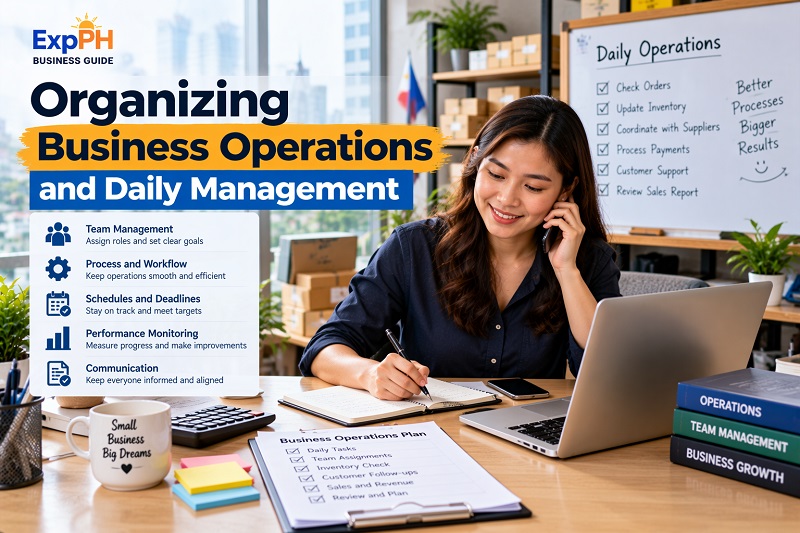
Organizing daily business operations helps entrepreneurs maintain product quality, control expenses, and provide consistent customer service. Establishing reliable suppliers, managing inventory, and creating standard operating procedures can improve efficiency. Using appropriate technology also helps simplify routine tasks and keep business activities organized as operations grow.
Establish Reliable Suppliers
Suppliers affect the quality, availability, and cost of your products.
Before choosing a supplier, evaluate product quality, pricing, delivery schedules, payment terms, reliability, and communication.
Whenever possible, identify alternative suppliers for essential products or materials.
Depending on the business, relying on only one supplier can create problems if that supplier experiences stock shortages or delivery delays.
Manage Inventory Properly
Inventory management is particularly important for retail, food, and manufacturing businesses.
Poor inventory management can lead to expired products, damaged goods, overstocking, and lost sales.
Maintain records of incoming and outgoing inventory.
Monitor fast-moving products and identify items that remain unsold for extended periods.
For food businesses, pay particular attention to proper storage, product handling, expiration dates, and sanitation.
Create Standard Operating Procedures
Standard operating procedures (SOPs) describe how routine business activities should be completed.
Examples include:
- Opening and closing procedures.
- Customer order processing.
- Payment handling.
- Inventory checking.
- Product preparation.
- Delivery coordination.
- Complaint handling.
- Cleaning and maintenance.
Even a small business benefits from written procedures because they reduce dependence on memory and make tasks easier to delegate.
Use Technology to Improve Efficiency
Technology can help entrepreneurs organize daily business activities.
Depending on your needs, useful tools may include:
- Spreadsheet applications for budgeting and inventory.
- Accounting software for financial records.
- Point-of-sale systems for sales transactions.
- Customer relationship management tools.
- Online payment platforms.
- Website builders and e-commerce platforms.
- Cloud storage for business documents.
Choose tools that solve actual business problems instead of paying for software you do not need.

10. Building a Marketing Strategy for Your Business
A marketing strategy helps customers discover your business and understand the products or services you offer. Building brand awareness does not always require expensive advertising. By establishing a clear business identity and using suitable marketing channels, you can attract potential customers and build lasting relationships.
Establish Your Business Identity
Your business identity should communicate what your company offers and why customers should consider purchasing from you.
Develop a consistent business name, logo, product presentation, and communication style.
Make sure your branding reflects your actual products and services.
Avoid making exaggerated claims about product performance, business results, or customer benefits.
Use Social Media Marketing
Social media platforms can help businesses reach customers and communicate with their communities.
Depending on your target market, you may use Facebook, Instagram, TikTok, or other suitable platforms.
Useful content includes:
- Product photographs.
- Service demonstrations.
- Customer education.
- Business announcements.
- Product availability.
- Customer testimonials used with permission.
- Frequently asked questions.
Focus on providing useful information rather than publishing promotional messages every day.
Build a Business Website
A website gives customers a central place to learn about your business.
It can contain product information, service descriptions, contact details, business location, operating hours, and ordering instructions.
For online businesses, a website can also support product catalogs, inquiries, and transactions.
Your website should be mobile-friendly, easy to navigate, secure, and regularly maintained.
Encourage Customer Reviews and Referrals
Satisfied customers can become an important source of new business.
Encourage customers to share honest feedback and recommend your products or services when they are happy with their experience.
Respond professionally to complaints and use customer feedback to identify areas that need improvement.
Never purchase fake reviews or misrepresent customer experiences.

11. Starting an Online Business in the Philippines
Starting an online business allows Filipino entrepreneurs to reach customers through websites, social media, and online marketplaces without relying entirely on a physical store. However, operating online still requires choosing a suitable business model and managing registration, payments, customer information, and legal responsibilities.
Choose the Right Online Business Model
Some common online business models include:
Online retail: Selling physical products through websites, social media, or online marketplaces.
Digital services: Providing services such as graphic design, writing, bookkeeping, and marketing.
Digital products: Selling downloadable educational materials, templates, or other digital resources.
Online education: Offering tutoring, training, or educational services.
Business-to-business services: Providing specialized services to other companies.
Each model has different operating requirements, costs, and customer acquisition methods.
Understand Online Business Registration Requirements
Online businesses are not automatically exempt from business registration and taxation requirements simply because they operate through the internet.
The Department of Trade and Industry explains the basic registration pathways for online businesses, including DTI registration for sole proprietorships and SEC registration for corporations. DTI ECommerce+1
You should also check applicable local permits, BIR registration, consumer protection obligations, and any industry-specific requirements.
Select Appropriate Payment Methods
Customers may prefer different payment options depending on their location and purchasing habits.
Possible payment methods include bank transfers, digital wallets, payment gateways, and cash-on-delivery arrangements where available.
Before selecting a payment provider, review transaction charges, settlement periods, refund procedures, account requirements, and security features.
Keep proper records of all business transactions.
Protect Customer Information
Online businesses may collect names, contact details, addresses, and transaction information.
Handle customer information responsibly and follow applicable privacy requirements.
Use secure account credentials, restrict access to sensitive information, and avoid collecting personal details that are unnecessary for the transaction.
For businesses processing customer data, understanding the requirements of the National Privacy Commission is important.
Official guidance is available through the National Privacy Commission.

12. Hiring Employees and Managing a Business Team
As a business grows, hiring employees can help manage daily operations, increase capacity, and improve customer service. However, building a team also requires careful financial planning and compliance with employment regulations. Understanding when to hire and how to manage employees helps support sustainable business growth.
Determine When You Need Your First Employee
Consider hiring when:
- Customer demand regularly exceeds your capacity.
- Important tasks are being delayed.
- You need specialized skills.
- Business operations require longer working hours.
- You have sufficient cash flow to support compensation and related costs.
Do not hire simply because other businesses have employees.
Identify the specific responsibilities that need additional support and determine whether the business can sustainably afford the position.
Understand Employment Responsibilities
Employers must comply with applicable Philippine labor laws and regulations.
Depending on the employment arrangement, obligations may involve written employment documentation, minimum wage rules, working hours, statutory benefits, payroll records, and government contributions.
Consult the Department of Labor and Employment (DOLE) for relevant labor guidance.
Official information is available through the Department of Labor and Employment.
Develop a Positive Workplace
Employees perform better when responsibilities and expectations are clear.
Provide appropriate training, establish communication procedures, and create a workplace where employees understand their responsibilities.
A well-organized team can help maintain consistent service quality as the business expands.
13. Common Mistakes to Avoid When Starting a Business
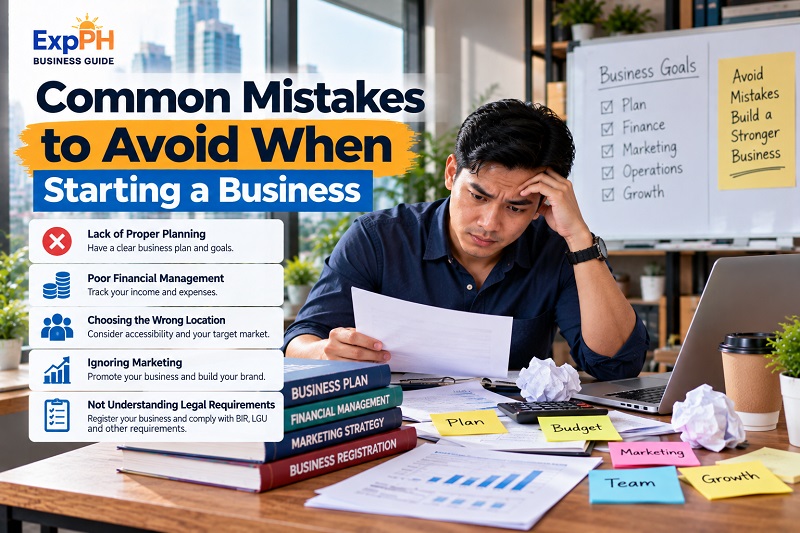
Starting a business without proper preparation can lead to financial losses and operational problems. Entrepreneurs should understand common mistakes involving market research, budgeting, registration, pricing, and customer service. Recognizing these risks early helps you make informed decisions and build a more sustainable business.
Starting Without Market Research
Choosing a business based only on personal interest or popularity can result in insufficient customer demand.
Research the market before investing significant capital.
Underestimating Startup and Operating Costs
Some entrepreneurs calculate equipment and inventory costs but forget rent, utilities, transportation, taxes, maintenance, and other recurring expenses.
Prepare a realistic budget that considers both opening costs and ongoing operations.
Ignoring Registration and Permit Requirements
Operating without the necessary registrations or licenses can create compliance problems.
Identify the requirements of your business structure, location, and industry before beginning operations.
Mixing Personal and Business Finances
Using one account for personal and business transactions makes it difficult to monitor actual performance.
Maintain organized financial records and separate business transactions as much as possible.
Setting Prices Without Calculating Costs
A product may attract customers but still lose money if the selling price does not cover its costs.
Consider materials, labor, packaging, delivery, overhead, and applicable taxes when determining prices.
Expanding Too Quickly
Opening additional branches or purchasing more inventory before establishing stable operations can create financial pressure.
Expand when customer demand, cash flow, management capacity, and operational systems support the decision.
Ignoring Customer Feedback
Customer complaints can reveal problems with pricing, product quality, delivery, and service.
Listen carefully and make practical improvements.

14. How to Grow and Scale Your Business in the Philippines
Growing a business requires more than increasing sales. Entrepreneurs should monitor financial performance, improve existing products and services, strengthen marketing efforts, and delegate responsibilities effectively. Careful planning helps determine when the business is ready to expand its operations and take on additional costs and responsibilities.
Monitor Your Business Performance
Track important business indicators such as:
- Monthly revenue.
- Gross profit.
- Operating expenses.
- Net profit.
- Cash flow.
- Customer retention.
- Inventory turnover.
- Outstanding payments.
Review these figures regularly to understand what is working and what needs improvement.
Improve Existing Products and Services
Before introducing new products, evaluate whether your current offerings meet customer expectations.
You may discover opportunities to improve packaging, service delivery, product quality, pricing, or customer support.
Small improvements can strengthen your existing business without requiring a major investment.
Expand Your Marketing Channels
Once you understand which marketing activities produce useful results, consider expanding to other channels.
For example, a retail business might combine a physical store with online selling. A professional services company might build partnerships and publish educational content to attract new clients.
Choose marketing channels based on customer behavior and available resources.
Consider Hiring and Delegating
Business owners often handle too many responsibilities themselves.
As operations become more complicated, delegation can help improve productivity.
Create clear procedures and assign responsibilities based on employees’ skills and experience.
Expand Carefully
Expansion may involve additional locations, new product lines, new markets, or increased production capacity.
Before expanding, evaluate:
- Available working capital.
- Expected customer demand.
- Additional operating expenses.
- Staffing requirements.
- Supplier capacity.
- Regulatory requirements.
- Potential financial risks.
A business should expand because its operations and finances can support growth, not simply because expansion appears attractive.

15. Building a Sustainable Business for the Long Term
Building a sustainable business requires consistent management and responsible decision-making. Entrepreneurs need to maintain financial discipline, understand industry changes, and develop strong customer relationships. Following responsible business practices also helps protect the company’s reputation and create a stable foundation for long-term success.
Maintain Financial Discipline
Review your expenses regularly and identify unnecessary spending.
Maintain adequate records, monitor cash flow, and avoid taking on financial commitments that the business cannot reasonably support.
Consider working with an accountant or qualified financial professional when your transactions and tax responsibilities become more complex.
Keep Learning About Your Industry
Business conditions change over time.
Customer preferences, technology, supplier prices, competition, and government regulations can affect how a business operates.
Follow relevant industry developments and review your business strategy whenever important changes occur.
Build Strong Customer Relationships
Customers are more likely to return when they receive consistent value and dependable service.
Provide accurate product information, respond to inquiries, resolve complaints professionally, and deliver what your business promises.
Operate Responsibly
Responsible business practices include complying with applicable regulations, maintaining honest advertising, treating employees fairly, and handling customer information appropriately.
These practices help establish trust and support a business’s reputation.
16. Practical Checklist Before Opening Your Business
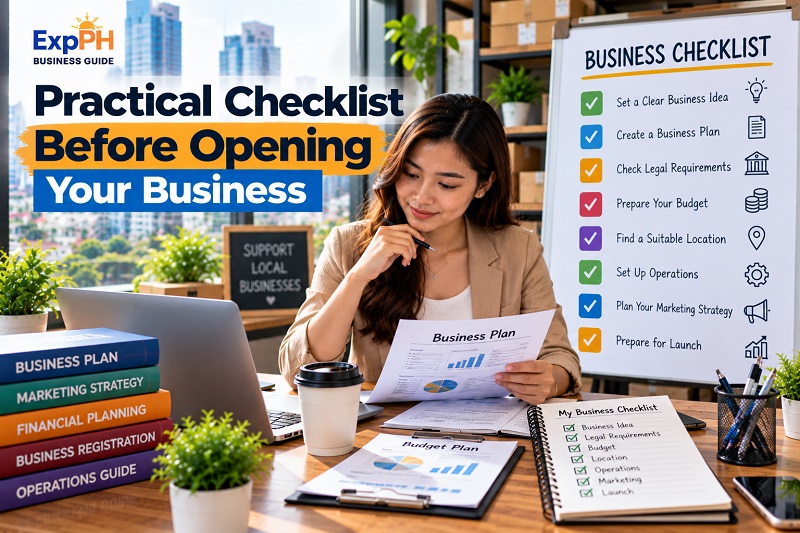
Before launching your business in the Philippines, review the essential steps to ensure you are prepared for daily operations and applicable legal requirements. This checklist covers business planning, market research, budgeting, registration, permits, taxes, suppliers, marketing, and other important responsibilities to address before opening.
- I have selected a business idea that addresses a real customer need.
- I have researched my target market and competitors.
- I have evaluated my skills and available resources.
- I have estimated startup capital and monthly operating expenses.
- I have prepared a realistic business budget.
- I have selected an appropriate legal business structure.
- I have completed the applicable DTI or SEC registration.
- I have checked local business permit and clearance requirements.
- I have addressed applicable BIR registration and tax obligations.
- I have prepared the necessary books of accounts and invoicing process.
- I have identified suppliers and operating requirements.
- I have established basic pricing and financial procedures.
- I have prepared a marketing strategy.
- I have organized customer service and daily operations.
- I have checked applicable employee and industry-specific requirements.
This checklist is a planning aid, not a complete list of legal requirements for every business. Confirm your actual obligations with the appropriate government agencies.

17. Official Philippine Government Resources for Business Owners
Official government resources help entrepreneurs understand business registration, tax obligations, employment regulations, and data protection requirements. Using these sources allows business owners to check the latest procedures and documentary requirements directly from the responsible agencies before submitting applications or making important compliance decisions.
The following resources are useful starting points:
| Government agency | Purpose | Official resource |
|---|---|---|
| Department of Trade and Industry | Sole proprietorship business name registration | DTI BNRS |
| Securities and Exchange Commission | Partnership and corporation registration | SEC eSPARC |
| Bureau of Internal Revenue | Tax registration and compliance | BIR |
| Philippine Business Hub | Business application gateway | Philippine Business Hub |
| Department of Labor and Employment | Employment and labor regulations | DOLE |
| National Privacy Commission | Personal data protection | NPC |
Government requirements and online procedures may change. Always confirm the latest instructions, applicable fees, and documentary requirements before submitting applications.

18. FAQs About Starting a Business in the Philippines
1. How do I start a business in the Philippines?
Start by researching your business idea, identifying customers, preparing capital, choosing a legal structure, completing registration, securing permits, and organizing operations before opening.
2. How much capital do I need to start a business in the Philippines?
Capital requirements depend on your business type, location, equipment, inventory, permits, and operating expenses. Prepare a realistic budget before investing your money.
3. Do I need to register my small business in the Philippines?
Yes, businesses generally need applicable registrations and permits. Requirements depend on ownership structure, activities, location, and relevant government regulations.
4. Should I register my business with DTI or SEC?
Sole proprietorship business names generally register with DTI, while partnerships and corporations register with SEC under applicable requirements.
5. Can I start a business from home in the Philippines?
Yes, certain businesses can operate from home, provided they comply with applicable registration, zoning, local permits, and industry-specific requirements.
6. What government agencies are involved in business registration?
Common agencies include DTI, SEC, BIR, and local government units. Additional agencies may apply depending on your business activities and industry.
7. Do online businesses need registration in the Philippines?
Yes, online businesses generally have applicable registration, taxation, and consumer protection obligations, regardless of whether transactions happen through websites or social media platforms.
8. How can I calculate my business startup capital?
Add equipment, inventory, registration, rental deposits, marketing, and initial operating expenses. Include emergency funds to support unexpected costs during operations.
9. What is the most important thing to consider before starting a business?
Understand customer demand, competition, available capital, operating expenses, and regulatory requirements. These factors help determine whether your business idea is practical.
10. How can I make my business successful in the Philippines?
Focus on customer satisfaction, financial discipline, consistent product quality, effective marketing, regulatory compliance, and continuous improvement as your business develops.
Final Thoughts: Building a Business That Can Grow
Starting a business in the Philippines requires preparation, patience, and a clear understanding of your customers and financial responsibilities. There is no guarantee that every business idea will succeed, but careful planning can help entrepreneurs avoid common mistakes and make more informed decisions.
You do not need to establish a large company immediately. Many entrepreneurs begin with a small operation, learn from their customers, improve their products, and gradually expand as their resources and experience increase.
The most important thing is to build a business around a genuine market need, understand the costs involved, comply with applicable regulations, and maintain responsible financial practices.
Whether you are interested in retail, agriculture, food production, professional services, technology, or another industry, the principles discussed in this guide provide a useful starting point.
Ultimately, starting a business in the Philippines is not just about opening an establishment or making your first sale. It is about creating a sustainable operation that provides value to customers and can support your long-term goals.
Test your knowledge of starting a business in the Philippines with this 10-question quiz
Results


#1. What should you do before investing in a business idea?
#2. What is the purpose of market research?
#3. Which expense should be included in a startup budget?
#4. Which agency handles sole proprietorship business name registration?
#5. Which agency registers corporations in the Philippines?
#6. Why should business and personal finances be separated?
#7. Which is an example of an online business model?
#8. What should businesses consider when choosing payment methods?
#9. What should entrepreneurs monitor to evaluate business performance?
#10. When should a business consider expanding?
We appreciate your time and participation
Share your score or quiz experience in the comments and encourage other aspiring Filipino entrepreneurs to test their knowledge too.

A Filipino web developer with a background in Computer Engineering. Founder of ExpPH Blog and ExpPH Business Guide, two Philippines-focused platforms covering OFW guidance, business, finance, freelancing, travel, and lifestyle. Passionate about helping Filipinos grow, he creates practical content that educates, empowers, and inspires readers nationwide.