
Starting and running a business is exciting, but one responsibility that every entrepreneur must understand early on is Business Taxes in the Philippines. Whether you operate a small sari-sari store, a home-based online shop, a freelance service, or a growing corporation, tax compliance is not optional. It is part of building a legitimate and sustainable enterprise.
Many new business owners feel overwhelmed by tax terms such as VAT, percentage tax, income tax, and withholding tax. The good news is that once you understand the basics and how they apply to your specific business structure, everything becomes clearer and more manageable.
This guide explains Business Taxes in the Philippines in simple and practical terms so you can stay compliant, avoid penalties, and build long-term credibility.
Before diving deeper into tax requirements, it is important to understand how taxes fit into your overall financial strategy. Read our complete guide on Business Finances in the Philippines (Complete Guide) to build a strong foundation for managing your finances effectively.
Table of Contents

Why Understanding Business Taxes in the Philippines Is Important
Before reviewing specific tax types, business owners must understand why tax knowledge plays a critical role in daily operations and long term growth. A clear understanding of Business Taxes in the Philippines helps entrepreneurs make informed decisions, avoid costly mistakes, and build a stable foundation for sustainable expansion.
Ensuring Legal Compliance and Protection from Penalties
Registering with the Bureau of Internal Revenue and paying the correct taxes protect your business from penalties, interest charges, and possible suspension. Proper compliance reduces legal risks and allows you to operate confidently within Philippine regulations.
- Maintain lawful business status
- Avoid fines and surcharges
- Prevent operational suspension
Improving Financial Planning and Pricing Strategy
Taxes directly affect pricing, profit margins, and cash flow management. When you understand your tax obligations, you can compute expenses accurately and set realistic prices. This helps protect your earnings while ensuring consistent compliance.
- Set sustainable pricing
- Plan cash flow properly
- Protect profit margins
Building Business Credibility and Professional Reputation
Tax compliant businesses are viewed as reliable and professional. Corporate and government clients often require official receipts and proper documentation. Meeting tax obligations strengthens your credibility and increases opportunities for long term partnerships.
- Attract larger contracts
- Issue official receipts
- Gain client trust
Increasing Access to Loans and Business Partnerships
Banks and investors usually request tax records before approving financing or collaborations. Organized and consistent tax compliance demonstrates financial responsibility and transparency, which improves your chances of securing funding for expansion.
- Support business growth
- Qualify for business loans
- Attract potential investors
Understanding Business Taxes in the Philippines goes beyond meeting government requirements. It is part of responsible entrepreneurship and strategic business management. When tax compliance becomes a structured practice, your enterprise becomes stronger, more credible, and better prepared for sustainable growth.
The Main Government Agency Responsible for National Tax Administration in the Philippines
All national internal taxes are administered by the Bureau of Internal Revenue under the Department of Finance. The BIR oversees tax registration, assessment, and collection across the country. Understanding its authority helps business owners comply properly and avoid costly legal or financial consequences.
Core Functions and Responsibilities of the Bureau of Internal Revenue
The Bureau of Internal Revenue manages essential tax processes that affect every registered business. Its responsibilities ensure that businesses follow national tax laws and maintain proper documentation throughout their operations.
- Tax audits and enforcement
- Business registration
- Issuance of Tax Identification Numbers
- Collection of income tax and VAT
Accessing Official Guidelines and Verified Tax Updates
For official guidelines, downloadable forms, and updated regulations, business owners should consult the BIR website at https://www.bir.gov.ph. Always confirm tax requirements using authoritative sources since policies may change. Relying on verified information reduces compliance errors and protects your business from unnecessary penalties.
4 Common Business Taxes in the Philippines
The taxes a business must pay depend on its legal structure, total gross income, and registration classification with the Bureau of Internal Revenue. Each category carries specific obligations and filing requirements. Below are the most common Business Taxes in the Philippines that entrepreneurs typically encounter during operations.
1. Income Tax
Understanding What Income Tax Means for Registered Businesses
Income tax is charged on net taxable income, which is calculated by subtracting allowable deductions from gross income. All registered businesses in the Philippines are subject to income tax regardless of structure. This obligation applies to sole proprietorships, partnerships, and corporations.
- Based on net taxable income
- Applies to all registered businesses
- Computed after allowable deductions
How Income Tax Rules Apply to Different Business Structures
Income tax treatment depends on the type of business entity and the tax option selected during registration. Knowing which category applies to your business ensures proper computation and compliance with filing requirements.
Sole Proprietors and Professionals
Self employed individuals are taxed using graduated income tax rates. Qualified taxpayers may choose the 8 percent tax on gross receipts instead of graduated rates.
- Based on eligibility rules
- Graduated income tax rates
- Optional 8 percent rate
Corporations
Corporations are generally subject to corporate income tax rates under prevailing laws. The applicable rate depends on current legislation and business classification.
- Based on company classification
- Corporate income tax rate
- Governed by existing laws
Income tax returns are typically filed on a quarterly basis and finalized annually according to official deadlines.
2. Value Added Tax (VAT)

Understanding What Value Added Tax Covers in Business Transactions
Value Added Tax is a 12 percent consumption tax imposed on the sale of goods, delivery of services, and certain imports in the Philippines. It is added to the selling price and collected from customers. Businesses registered for VAT must compute output and input taxes accurately.
- 12 percent standard rate
- Applies to goods and services
- Includes certain imports
Determining Who Must Register as a VAT Taxpayer
Businesses are required to register for VAT if their annual gross sales or receipts exceed the legal threshold. Under current regulations, the threshold is PHP 3,000,000. Entrepreneurs should verify updates directly through the Bureau of Internal Revenue to ensure accurate compliance.
- Confirm rules with BIR
- Exceeds PHP 3,000,000 sales
- Based on annual gross receipts
Core Compliance Duties of VAT Registered Businesses
VAT registered businesses have stricter documentation and reporting requirements compared to non VAT taxpayers. Proper compliance ensures accurate tax remittance and reduces audit risks under Business Taxes in the Philippines.
- Maintain detailed records
- Issue VAT official receipts
- File monthly VAT returns
- File quarterly VAT returns
VAT compliance is closely monitored by tax authorities due to its impact on national revenue collection.
3. Percentage Tax
When Percentage Tax Applies to Small and Non VAT Businesses
Businesses whose annual gross sales do not exceed the VAT threshold and are not registered as VAT taxpayers are generally subject to percentage tax. This tax structure is common among small enterprises and startups beginning their compliance journey.
- Below VAT threshold
- Not VAT registered
- Common for small firms
How Percentage Tax Is Computed and Filed
Percentage tax is calculated as a fixed percentage of gross sales or receipts. It is simpler than VAT because it does not require input and output tax computations. Businesses file percentage tax returns on a quarterly basis following official deadlines.
- Filed every quarter
- Based on gross receipts
- No input output system
Percentage tax provides a more straightforward compliance option for qualifying businesses while they continue to grow and scale operations..
4. Withholding Taxes

Understanding How Withholding Taxes Work in Business Payments
Withholding taxes are amounts deducted from certain payments before releasing funds to employees, suppliers, or contractors. The business withholds the tax and remits it directly to the Bureau of Internal Revenue. This system ensures proper tax collection at the source.
- Deducted before payment
- Remitted to the BIR
- Applied to specific transactions
2 Common Types of Withholding Taxes Businesses Must Follow
Businesses may encounter different withholding tax categories depending on their transactions and workforce structure. Understanding each type helps ensure accurate deductions and timely remittance.
1 Withholding Tax on Compensation
This tax is deducted from employee salaries based on income tax tables and is regularly remitted to the BIR.
- Filed and remitted regularly
- Based on salary income
- Deducted from payroll
2 Expanded Withholding Tax (EWT)
Expanded withholding tax applies to certain business payments such as professional fees, rental payments, and contractor services.
- Includes contractor services
- Covers professional fees
- Applies to rental payments
If you hire employees or pay service providers, compliance with withholding tax regulations is generally required under Philippine tax laws.
Other Possible Taxes
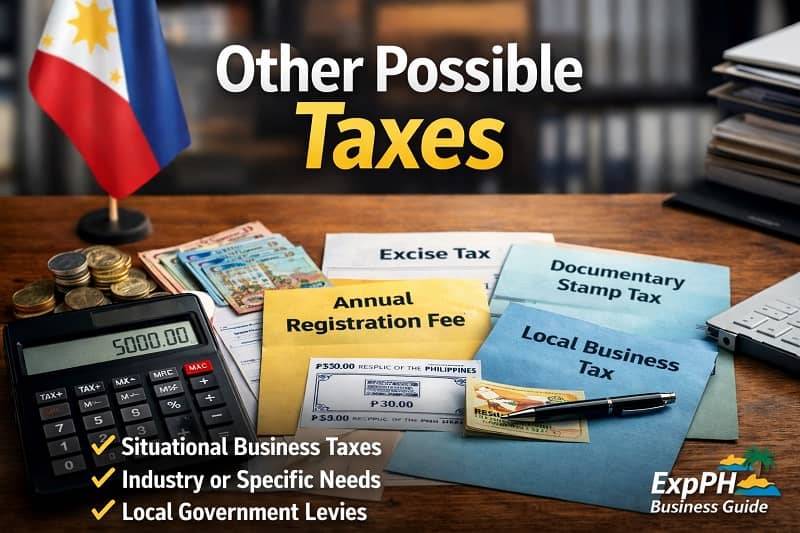
Aside from national taxes such as income tax and VAT, businesses in the Philippines may also be required to pay additional taxes depending on their industry, products, and location. These taxes are not applied to all businesses but are based on specific activities and local government regulations.
Additional Taxes That May Apply Based on Industry and Location
Some businesses may be subject to additional obligations depending on the nature of their operations and local requirements. These taxes vary based on business activity and industry type.
Common examples include:
- Annual Registration Fee
- Documentary Stamp Tax
- Excise Tax for specific goods
- Local Business Tax
Understanding Local Business Tax and Registration Requirements
Local Business Tax is imposed by the city or municipality where the business operates. Rates and requirements vary depending on local ordinances and business classification. In addition, businesses must pay an annual registration fee to maintain active status.
Local business taxes are paid to your city or municipal hall and are separate from national taxes collected by the Bureau of Internal Revenue.
Key points to remember:
- Renewed annually
- Paid to local government
- Based on local ordinances
- Required for business permits
Basic Tax Compliance Requirements
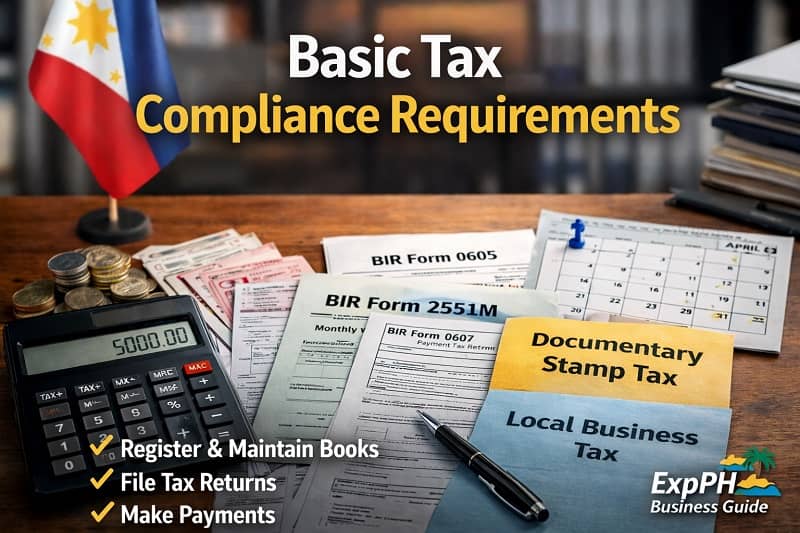
Complying with business taxes in the Philippines involves more than just paying the correct amount. Business owners must follow proper registration, documentation, and reporting procedures to operate legally and avoid penalties. This includes registering with the appropriate government agencies, maintaining accurate financial records, and issuing authorized receipts for every transaction.
Following Proper Procedures Beyond Paying Taxes
Understanding business taxes goes beyond calculation. Compliance requires organized records, complete registrations, and timely submissions to maintain lawful operations.
Key practices include:
- Follow official procedures
- Complete required registrations
- Maintain accurate records
Completing Business Registration Before Starting Operations
Before operating legally, businesses must register with the appropriate government agencies. This process establishes your tax identity and allows you to issue official receipts.
Registration steps include:
- Register business name with DTI or SEC
- Register with the Bureau of Internal Revenue
- Secure local permits and barangay clearance
- Obtain Certificate of Registration
The BIR issues the Certificate of Registration and approves official receipts after successful registration.
Maintaining Proper Books of Accounts for Accurate Reporting
All registered businesses are required to keep books of accounts to track income and expenses. These records support accurate tax filing and serve as documentation during audits or financial reviews.
Common books include:
- Cash receipts book
- Cash disbursements book
- General journal and ledger
Businesses may use manual books or apply for a computerized accounting system with approval.
Issuing Authorized Official Receipts and Invoices
Issuing BIR authorized receipts or invoices is mandatory for every sale or service transaction. This ensures proper documentation and compliance during audits.
Best practices include:
- Use BIR approved receipts
- Issue receipts for every sale
- Keep duplicate copies for records
Practical Tips for Managing Business Taxes in the Philippines
Staying Organized and Consistent With Tax Compliance
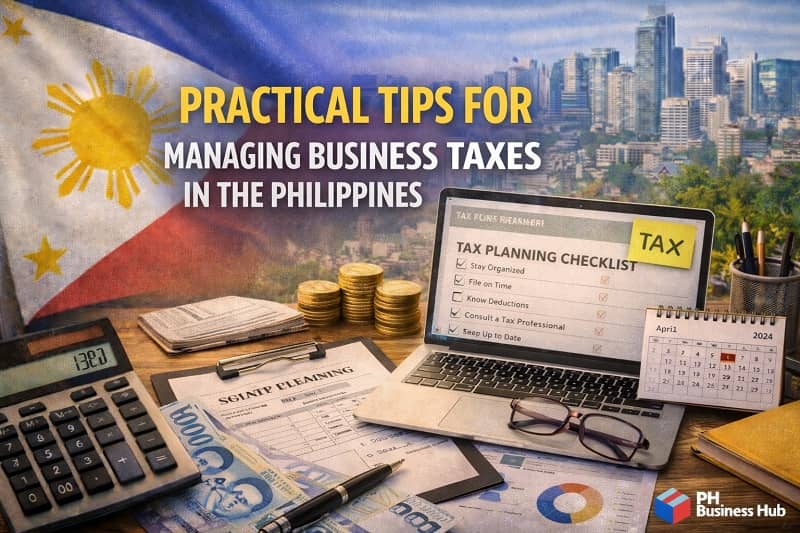
Managing Business Taxes in the Philippines requires discipline and proper systems. Staying organized reduces stress and prevents costly mistakes. With clear processes and reliable tools, business owners can meet filing deadlines, maintain accurate records, and protect their operations from unnecessary penalties.
- Avoid preventable penalties
- Build structured systems
- Monitor records consistently
Separating Business and Personal Finances for Clear Tracking
Keeping business and personal finances separate improves transparency and simplifies tax reporting. Opening a dedicated business bank account allows you to monitor income and expenses accurately. This separation also strengthens financial discipline and makes audit preparation easier.
- Record expenses properly
- Open business bank account
- Track income clearly
Using Digital Tools to Maintain Accurate Financial Records
Accounting software or spreadsheets help organize financial data and reduce manual errors. Digital tools make it easier to monitor sales, expenses, tax payments, and filing deadlines. Reliable recordkeeping supports accurate reporting and improves overall financial management.
- Set deadline reminders
- Monitor sales records
- Track business expenses
- Record tax payments
Marking Tax Deadlines to Avoid Penalties and Interest
Late filing leads to penalties, surcharges, and interest charges. Creating a calendar reminder system ensures timely submission of required returns. Consistent monitoring of due dates protects your business from unnecessary financial losses.
- Annual income tax return
- Monthly filings
- Quarterly returns
Considering Professional Help as Your Business Expands
As your business grows, tax compliance becomes more complex. Hiring an accountant helps ensure correct tax computation and proper documentation. Professional guidance is valuable when handling VAT reporting and multiple withholding tax obligations.
- Plan legal tax strategies
- Ensure accurate computation
- Prepare for possible audits
Common Mistakes to Avoid
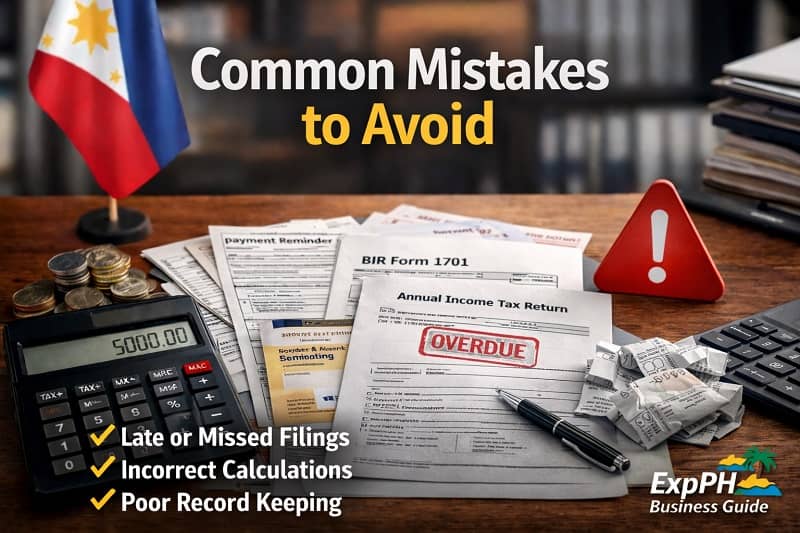
Avoiding these common mistakes strengthens your compliance practices and helps build a stable and responsible enterprise in the Philippines.
Overlooking Basic Tax Responsibilities That Lead to Compliance Problems
Many entrepreneurs encounter tax issues not because regulations are too complex, but because they ignore small yet important requirements. Overlooking registration steps, documentation rules, or deadlines often leads to penalties and operational stress that could have been prevented with proper attention.
- Missed compliance steps
- Incomplete registration
- Poor record management
Failing to Register the Business Before Starting Operations
Operating without proper registration exposes the business to penalties and possible suspension. Entrepreneurs must complete registration with the appropriate agencies before issuing receipts or offering services to customers.
- No legal tax status
- No BIR registration
- Missing local permits
Mixing Personal and Business Finances
Combining personal and business funds creates confusion in tracking income and expenses. This practice increases the risk of inaccurate tax reporting and weakens financial transparency during audits or loan applications.
- Inaccurate income tracking
- Shared bank accounts
- Unclear expense records
Ignoring Official Receipt Requirements and Filing Deadlines
Failure to issue authorized receipts or submit tax returns on time can result in fines and interest charges. Timely filing and proper documentation protect your business from avoidable compliance problems.
- Accumulated penalties
- No official receipts
- Late tax submissions
How Business Taxes in the Philippines Support National Growth
Business Taxes in the Philippines help fund essential public services such as infrastructure projects, public healthcare, education systems, and social development programs. Although tax payments may feel like an added expense, compliant businesses play a direct role in supporting national progress and long term economic stability.
For business owners, consistent tax compliance also strengthens credibility and trust. Customers, suppliers, banks, and investors prefer working with legally compliant enterprises. Responsible tax practices signal professionalism, financial discipline, and commitment to ethical operations within the Philippine business environment.
FAQs About Business Taxes in the Philippines
What are the main business taxes in the Philippines?
The main business taxes include income tax, value added tax, percentage tax, and withholding taxes. Local governments also collect business permits and local business taxes annually.
Who needs to register with the BIR?
All individuals and entities operating a business must register with the Bureau of Internal Revenue before starting operations to legally issue receipts and file required tax returns.
What is the difference between VAT and percentage tax?
VAT is a 12 percent tax on sales exceeding the threshold, while percentage tax applies to non VAT businesses with lower annual gross receipts.
How often should businesses file tax returns?
Filing frequency depends on the tax type. Some returns are filed monthly, others quarterly, and income tax is typically filed both quarterly and annually.
What happens if a business misses a tax deadline?
Missing a deadline may result in penalties, surcharges, and interest charges. Consistent non compliance can lead to audits or possible suspension of business operations.
Do small online sellers need to pay business taxes?
Yes, online sellers must register and comply with tax laws if they operate regularly for profit. Digital businesses are treated similarly to physical stores.
What is the 8 percent income tax option?
The 8 percent option allows qualified self employed individuals to pay a flat rate based on gross sales instead of graduated income tax rates.
Are freelancers required to pay business taxes?
Freelancers earning income from services must register as self employed professionals, issue official receipts, and file income and percentage or VAT returns.
What records should businesses keep for tax purposes?
Businesses should maintain books of accounts, official receipts, expense records, and copies of filed returns to support accurate reporting and prepare for possible audits.
Can a business hire an accountant for tax compliance?
Yes, hiring an accountant helps ensure accurate computation, timely filing, and proper documentation. Professional guidance reduces errors and supports better financial planning decisions.
Final Thoughts on Business Taxes in the Philippines
Understanding Business Taxes in the Philippines is a critical step toward building a sustainable and credible enterprise. Income tax, VAT, percentage tax, and withholding obligations each affect your financial structure and daily operations. When business owners understand how these taxes work, they can make better pricing decisions, manage cash flow properly, and avoid costly penalties. Tax knowledge strengthens stability and supports smarter long term planning.
Success depends on staying informed, organized, and proactive. Proper registration, accurate recordkeeping, and careful monitoring of deadlines protect your business from compliance risks. Seeking professional advice when needed ensures correct tax computation and reporting. When tax compliance becomes part of your overall strategy rather than a burden, your business becomes more resilient, credible, and ready for expansion in the Philippine market.
Related Finance Articles
- Cash Flow Management Tips for Small Businesses in the Philippines
- How to Separate Personal and Business Finances Properly
Learning Hub Quiz!
Test your knowledge of basic business taxes and see how ready you are to operate confidently.
Results


#1. Which agency collects national business taxes?
#2. Which tax applies to net taxable income?
#3. What is the standard VAT rate?
#4. Percentage tax usually applies to?
#5. What must businesses issue for sales?
#6. Which tax is withheld from employees?
#7. When is income tax commonly filed?
#8. What helps track tax records?
#9. Who must register before operating?
#10. Why is tax compliance important?
Thank you for taking the quiz.
Share your score or experience in the comments and let us know which topic you want to learn next.

A Filipino web developer with a background in Computer Engineering. Founder of ExpPH Blog and ExpPH Business Guide, two Philippines-focused platforms covering OFW guidance, business, finance, freelancing, travel, and lifestyle. Passionate about helping Filipinos grow, he creates practical content that educates, empowers, and inspires readers nationwide.